David L. Traut, CAPS
In 1974 while obtaining a graduate degree from the University of Texas at Austin an innate talent was acknowledged and T-Square Company was formed as a means to remodel both friends and Professors homes. This began a quest for constructive footprints leading to a lifetime of challenge. My researching practices evolved into the art of building the most efficient structures possible utilizing the ever changing technologies benefiting construction.
With over three decades of experience in both residential and commercial construction techniques a hybrid type of building became available to our clients insuring a successful completion of their projects. We incorporate our in house craftsmen with a qualified group of licensed subcontractors to get your project done professionally, in budget, and on time.
A completely serviceable special needs bathroom must contain ADA vanities and the accessible route must be defined. The vanity must be one with a clear underneath scald protected area having an unobstructed roll under capability for wheelchairs. A five foot turning radius allowing the wheelchair to maneuver an approach must also be associated with the ADA vanity. The area of travel will then be enhanced by an unobstructed clear accessible barrier free route dedicated to reaching the vanity.

Whether the job concerns ADA remodeling or new construction, commercial or residential, the end result will always be the same in aiding those who no longer or have never had the choice of a means of locomotion. Sometimes folks need a little help beyond the rest of us to be self sufficient and hold on to their dignity. That's when the clear accessible route comes into play. This designated route will make it possible for those with special needs to enter through the front door and travel into any room of the structure without barriers especially entering the accessible bathroom.

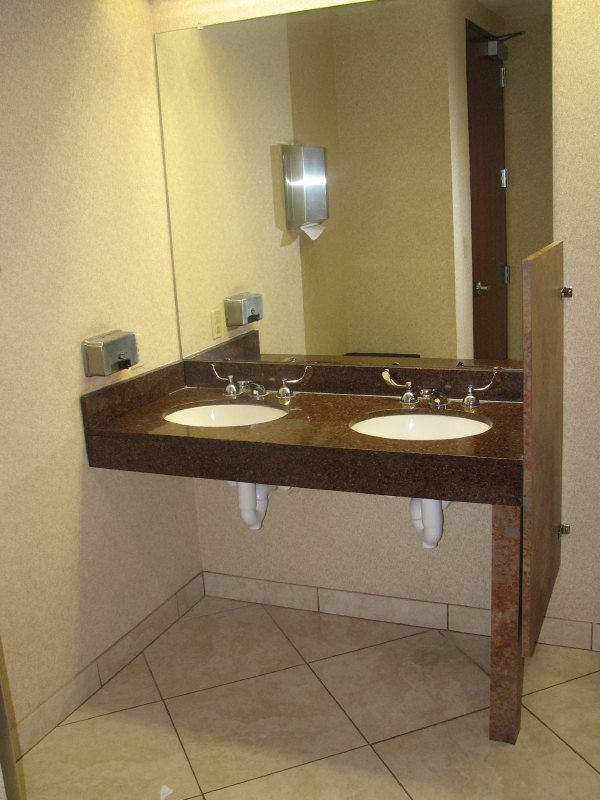
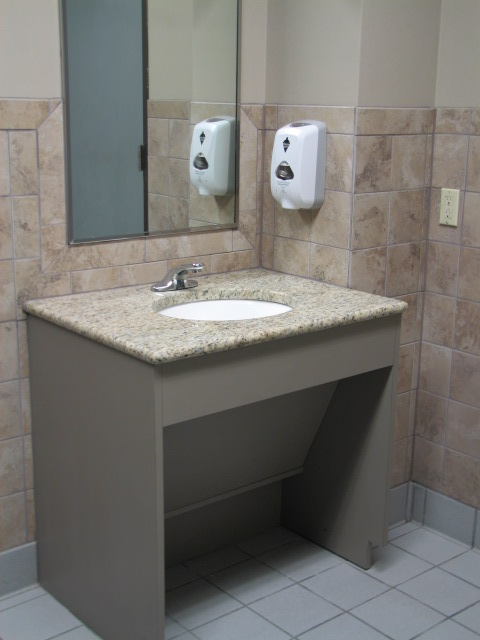
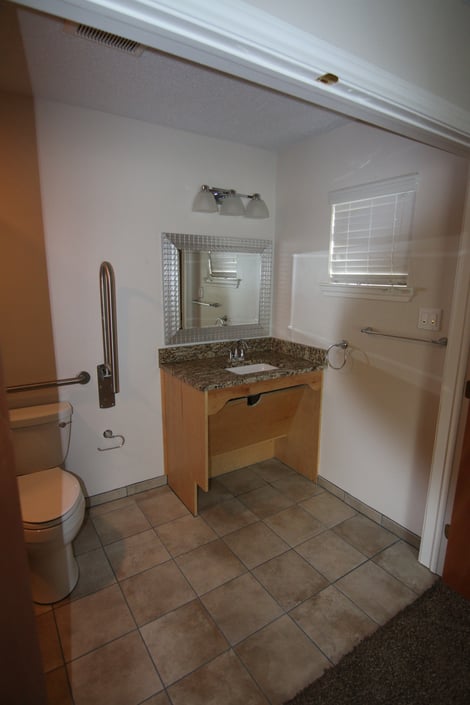
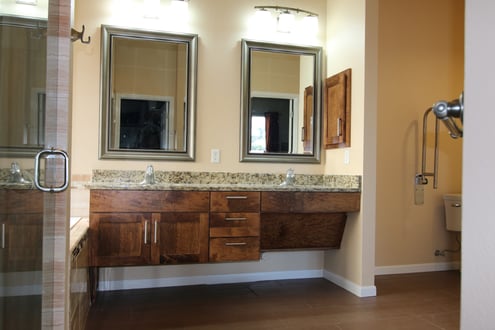
There are basically two styles of ADA bathroom vanities that comply with an unobstructed roll under area below the sink. This capability has everything to do with both the water supply lines and the main waste line connecting the sink. There must be provisions made to protect the user from being scalded when coming into contact with any one of the plumbing pipes serving the sink. These connecting pipes may become heated merely by the water passing through them creating the problem. The open type model should always receive both waste and supply insulating jackets applied directly to the pipes providing protection for the wheelchair user. The closed model concealing the pipes will be equipped with a removable face or face board covering the pipes. This pipe concealing panel must be installed at the correct angle. This allows for the needed unobstructed legroom required for the user. The vanity can extend beyond the sink but the area containing the sink is required to have this roll under capability. This section of the vanity must not be any taller than 34 inches above the finished floor with sufficient lower clearance. Clear unobstructed reach distances around the countertop area must be observed. Any motion controlled sensors integrated into the various dispensing devices and/or plumbing fixtures throughout the restroom present a true hands free benefit to all the restroom users. If these aren't in the budget then at least wrist handles used for controlling the faucet can be incorporated into the design of the vanity. Furthermore, automatic flush valves should be used on all toilets and urinals that provide for hands free use.

An Example of the First Type of ADA Vanity Using Pipe Insulation and a Wrist Blade Handled Faucet
An Example of the Second Type of ADA Vanity with a Removable Angled Face and a Motion Sensing Faucet
Regardless of whether there are special needs people working within a commercial building or not, we are required by law to make all the common areas ADA accessible. Homes provide a different situation when providing handicap home modifications because the alterations are put in place for specific full time occupants. The barrier free accessible route put in place must be observed as a means of life safety and function. You just never know when a personal life changing situation can appear requiring help for those with special needs. If one does occur we do have the means to offer aid and safety to those who have become afflicted in some unfortunate way and to help preserve their personal dignity and independence.
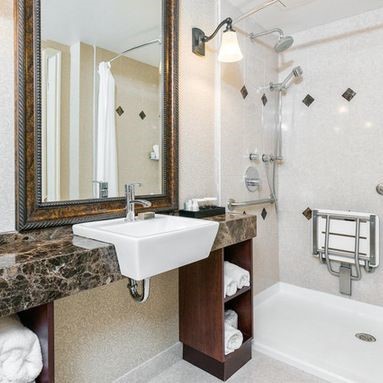

ADA Compliant Bathroom Vanities
Tags:
Austin,
Texas,
how-to,
commercial cabinetry,
ADA accessible,
accessible routes,
ADA bathroom cabinets accessible routes,
ADA remodeling,
ADA bathroom cabinets,
ADA compliance,
ADA vanities,
ADA remodeling Austin, Texas,
ADA bathroom Austin, Texas
You either feel like the time has finally arrived for you to become self employed or you have been considering a larger work space because of your situation. You have been weighing out how to go about such a change. Once you have found a building and negotiated your lease it's time to find a reputable tenant improvement contractor who can help you through the construction process.
Austin commercial Tenant finishes can vary from merely a paint job to demolishing the entire space and starting over to better utilize the square footage. Utilization requires planning in advance and knowing all your business's operational needs. Work areas will always be defined per function. Storage areas, breakrooms, conference rooms, and reception areas should be considered so that the entire office flows well during hours of operation. Shipping can definitely be a consideration even if it doesn't play a major part in your business. Maybe your space is large enough to include the addition of private restroom facilities in addition to those located within the common area?
Work areas hold the most importance since they are tied directly to the income of the business. Private offices will be assigned as needed. Larger open spaces for setting up cubicles or multiple work stations can take up the majority of your new floor space. Storage areas for office supplies and even shipping areas will take up space as needed by the tenant according to the type of business.

Breakrooms need to be sized according to the number of people using the facility at any one time. All care should be taken for providing ADA accessible routes throughout any of the shared usage areas. ADA compliant kitchen cabinets should be used within the break area that provide sink space at the proper height above the finished floor and the proper clearances with protection below the sink area. If you were fortunate enough to have private restroom facilities installed be sure they fall within ADA compliance. Special vanity and fixture requirements for height, clearance, and reach must be observed throughout the restroom. You never know when you might hire a person with special needs.
Conference rooms can be placed either off to the side or within the very center of your space. Ceiling,floor, and wall treatments can be upgraded here because they will help define this room as being special. Installing commercial window walls or even half glass walls can highlight any conference room within your space and still provide privacy for business meetings. Window treatments like blinds or drapes can be added to increase the room's privacy when needed. Be sure to prewire for any devices used during presentations and don't forget about controlling the room lighting.
Reception areas make the first impression on the people coming into your office for the first time. Careful consideration must be given to their presentation. Are there enough seats for the amount of people who will drop by at any one time? Are there accessible writing surfaces for anyone who enters even if they are in a wheelchair? Does the room provide comfort to those who are waiting for an appointment? Remember this room could set the tone for a very important future meeting involving your business.
Be sure you get the experienced help you need and always hire a local office construction company to help you make the decisions that will need to be made in order to have a successful project.
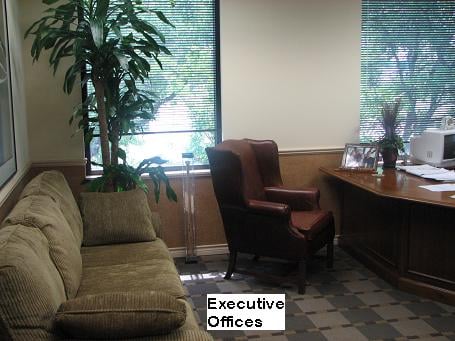
A Private Office Built For Comfort
Tags:
Austin,
Texas,
how-to,
ADA compliant kitchen cabinets,
Commercial Construction,
tenant finish outs,
window walls,
ADA accessible,
accessible routes,
ADA bathroom cabinets accessible routes,
ADA bathroom cabinets,
tenant improvement contractor,
ADA vanities,
ADA bathroom Austin, Texas,
tenant finish Austin Tx,
tenant improvements in Austin,
tenant improvement contractor Austin, Texas,
tenant modifications Austin, Texas,
tenant finish contractors Austin, Texas,
Austin tenant finish
When you have finally decided to pursue a personal building project for your home and are now ready to hire a residential construction contractor in Austin, Texas you must first verify the company's capabilities and completion record. First you really need to know just how reputable a business is before jumping on board with anyone. Is there an office or shop listed with a physical address and not just a P O Box. The safest way to validate any contractor's record and understand their business is by utilizing free listings available from your local Better Business Bureau either through their website or via the telephone. Any consumer can see if the contractor is not only a current member and for how long but if they are an accredited member with a rating given out by the BBB based on track records of the contractor. You can find out how long they've been in business and if there have any derogatory complaints against them. You can be assured that no money has changed hands for receiving the accreditation grade which is based on the total profile of the contractor's business. Don't get caught taking the easy route to a decision blindly trusting posted lists of trusted businesses that are available on the internet . Many say that no contractor can pay a fee to be listed on their approved sights; however, a fee was certainly paid by someone to be listed or the web sight could not exist.

After checking out the local business listing on the BBB why not look into the business owner himself. Linked In can provide you with some background on the business owner like educational experiences, how long they've been in business, and other general knowledge. Just how transparent is the business and is it in good standing? Yelp is another web site where a free listing about a business containing testimonials has been posted by their clients. You can verify if a business exists and find out more about them plus you can always ask for more references.

Now that you know the business actually exists and the owner is both local and somewhat reputable, you should take note in how they conduct their business. Is the contractor trying to do the job without a city permit not being registered with the city and county or does he have both general liability and workman's comp insurance? The old adage that "if there is a permit involved then my taxes surely will go up because of the improvements" gets shot down because city officials make sure the work is done in line with the accepted building code. The time to obtain the permit and it's fees surely outweighs the costs of the judgments you would have had to bring against the incompetent contractor once his methods failed. Now how about asking to see a current certificate of insurance for the company? The contractor must have general liability coverage to cover any accidental physical occurrences while working on your home. He must also have workman's comp insurance to keep any employees working on your home from suing you as the homeowner if they are hurt on the job.
I tell my customers all the time that one of their main ways of choosing a residential building professional in Austin, Texas with a good track record and BBB experience rating is the ability for them to do work with the particular residential building contractor they are interviewing. Can they communicate easily relying on the contractor's experience and reputation and can they get along throughout the sometimes long and detailed construction process? Are they compatible as human beings because the only energy that should be spent during the project should be directed toward it's completion.
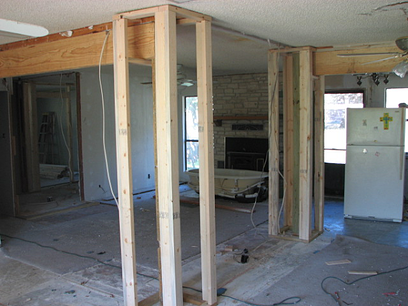
T-Square Company can help you with kitchen and bath remodels, room additions, or simply making your home more accessible for you or a loved one. Our design build projects will be customized to your fit your needs and are guaranteed to blend with your homes existing architecture. Let our over three decades of remodeling experience work for you.


After choosing your residential construction contractor you should never pay for everything up front. Payments should be associated with aspects of the job and you should always get something for your money. Soft costs like designs, permits, or fees can be paid in advance to get the project rolling plus any custom made entities or materials ordered and stocked on the job sight. Never let the contractor draw ahead of what is actually happening no matter how much you are caught up in the building process. Paying for a little overhead to a bonified construction professional will always cost more but usually saves you a lot in the long run. It's not always about the cheapest bid because you'll always get what you pay for. Get every aspect of the job in writing and both you and the chosen residential construction contractor must sign the document for it to be a binding contract.
!

Tags:
Austin,
Texas,
kitchen remodeling,
residential construction contractor,
how-to,
aging in place home improvements in Austin,
residential remodeling,
wheelchair accessible remodeling,
bathroom remodels,
ADA remodeling,
building professional,
accessibility home remodeling in Austin,
attic remodeling,
home modifications for independent living,
aging in place services,
renovation contractor in Austin, texas,
residential remodeling contractor in Austin,
residential remodeling company in Austin, Texas,
professional remodeling contractor,
home remodeling near me,
professional remodeler,
home remodeling professional,
home remodeling contractors residential
You've spent your time looking through the internet examples of bathroom remodeling. You've gazed at all the remodeling books offered at the local grocery and lumber box stores. Now you've come to the conclusion thatnone of them immediately suits your current situation. The pictures you studied of fine bathroom makeovers are composed of lavish bathrooms with huge footprints way beyond the scope of your modestly sized room needing a fine bathroom upgrade.

Bathroom sizes are usually dictated in some respect by the length of the tub which in most cases is five to six feet long. This is evidenced by a tub that has been installed opposite the entry wall producing a wall to wall tub situation. In this configuration the toilet and vanity are generally placed on one of the walls that are perpendicular to the length of the tub. Here is a great starting point to gain space for a larger custom walk in shower to replace the tub you never use. But if you are fortunate to have both wall lengths exceed the five or six feet norm then space is not an issue and you can proceed with ease. Just choose your finishes wisely and keep all choices within your budget.
If you're current situation is cramped but you already have a double vanity, you might gain space for a new shower expansion by either shortening the vanity while keeping the two sinks or by going with one single sink located in the middle of a shorter vanity. This can be accomplished by capping off one sink drain completely and/or deleting the water supply stops. If your toilet is located between the vanity and tub then shortening the vanity is all for naught. You can move the toilet over but this means breaking out the floor to change the toilet plumbing floor flange plus the water supply. Be careful as this alteration can be costly and should only be done to allow certain specific situations to evolve.
Moving on to either the tub removal bringing about a walk in shower design or the tub's replacement highlighted with a custom shower surround, you'll have to decide what will be of the most use to you. A tub surround limits your creativity but you can still enjoy a couple of shampoo nooks installed between your existing studs before any tiling takes place. Replacing the old tub/shower valve and tub spout will also give you a shiny feeling of newness. A new glass enclosure will provide a revived look plus the more expensive frameless models will bring your bathroom completely up to date.
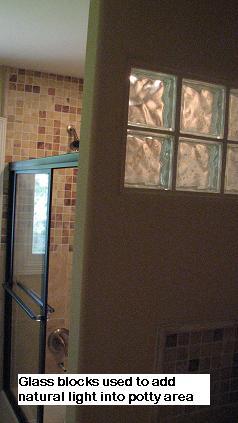
If deleting the tub to achieve a custom walk in shower design is your choice then you have a few options to consider. Do you wall in two thirds of the width of the old tub placing the new door away from the shower head? This new wall can be tiled in to match the shower and can also have glass blocks inserted into it for natural light to prevent claustrophobia. Do you desire a full length curb to accommodate a taller ready made glass enclosure or even the more expensive frameless model set beside a glass panel? The designs are limited only by your imagination and how you want the final product to turn out. Be sure that all your research is justified and don't try to cram too much into your new bathroom remodel. A good design is one that can come into being with the least time spent on alterations and additional costs.
If you're uncertain about how to proceed during Austin bath transformations always rely on a local and trusted building professional. Sometimes spending a little money for experienced help with design and construction techniques can save you a lot during the construction process.

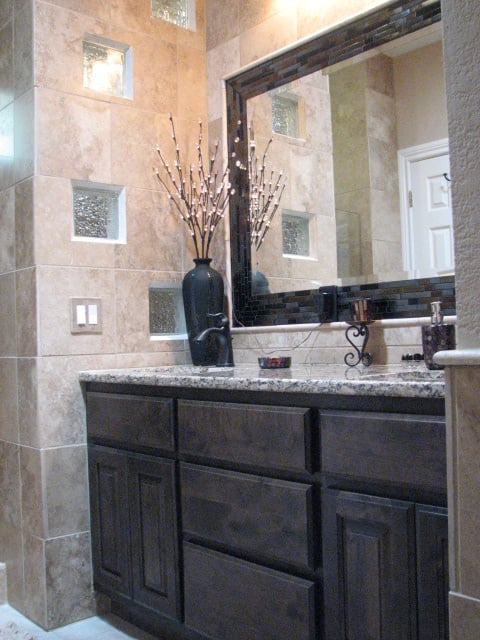
A Tub to Shower Conversion with Seat Derived From a Shorter Vanity with Glass Block Inserts
Accessible Bathrooms In Austin
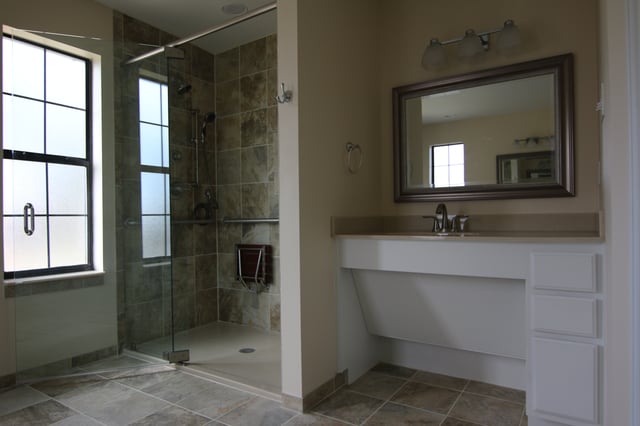
Universal design and aging in place services in Austin have finally taken hold in the residential remodeling industry. The current housing inventory doesn't offer the features needed for safety and accessibility in the numbers needed to accommodate the growing demand. It is ultimately up to the homeowners and their families to plan for future housing needs. Our existing architecture does not lend itself well to accomplishing any easy aging in place home remodels in Austin. In fact, there are more inaccessible homes in all of the US than there are accessible homes and 45% of these existing homes are owned by the baby boomers representing the oldest group of homeowners. Generally speaking in most residential US properties there are no easy ways to enter into bathrooms or utilize kitchens without coming into contact with one architectural barrier or another-especially if a wheelchair or walker is being used to help with mobility issues. Everything requires the proper clearance and distance for a new customized accessible route in your home to function properly. Please consider this aspect in your design if an elderly parent will be coming to visit or you yourself suffer an unfortunate accident or develop a debilitating disease.
The National Association of Home Builders, in partnership with the AARP and Home Innovation Research Labs, created the CAPS program, which includes training and education on the technical, business management and customer service skills essential to compete in the fastest growing segment of the residential remodeling industry--home modifications for aging in place. David L. Traut, CAPS the owner of T-Square Company in Austin, Texas is one of the select group of professionals nationwide to earn the Certified Aging-In-Place Specialist (CAPS) designation, identifying him as a home remodeler and builder with the skills and knowledge necessary to remodel or modify a home to meet the unique needs of the older population, disabled owners or their visitors. Call us at 512-444-0097 to see how we can help you design your bath for the future.

Tags:
Austin,
Texas,
how-to,
fine cabinetry,
aging in place home improvements in Austin,
bathroom remodeling,
fine bathroom upgrades-bathroom cabinetry,
fine bathroom upgrades,
bathroom remodels,
glass block designs,
custom walk in showers,
ADA bathroom cabinets,
accessibility home remodeling in Austin,
Austin bath remodeling,
Austin bath remodel,,
Austin bathroom remodel,
bathroom modifications for elderly,
aging in place specialist,
aging in place services,
bathroom renovations in Austin, Texas,
bathroom remodeling contractor Austin Texas,
bathroom remodeling Austin Texas,
bathroom upgrades Austin,
bathroom modifications for disabled,
bathroom cabinets Austin Texas,
bathroom accessibility remodels in Austin,
accessibility remodelers in Austin
Remodeling your existing master bath to obtain an often dreamed of larger shower doesn't always mean adding square footage to your existing bathroom. Whether your doing a tub to shower conversion, utilizing the existing uncomfortable tub and shower spaces together, or merely enlarging your existing shower you can reach a more comfortable feeling by changing your existing layout and utilizing your existing bathroom's square footage. Fine bathroom upgrades usually involve an efficiency of space usage plus getting rid of any unused or abused space like inefficient closets or wasted storage areas. This situation can be addressed in the design of your future fine cabinetry.
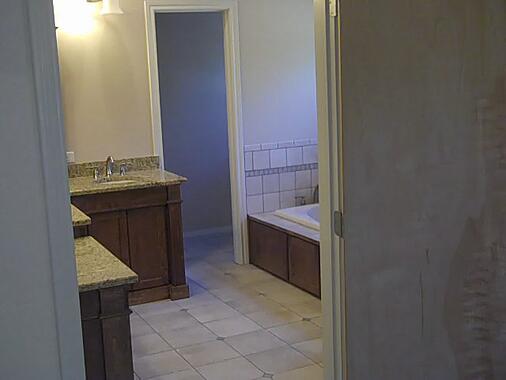
A tub to shower conversion for a custom walk in shower can provide easier access helping with mobility issues. There's no stepping over the side of the tub. The custom walk in shower in Austin, Texas access can be made into a raised threshold type used in a wheelchair roll in situation that solves accessible ADA issues or it can involve a small 4-6 inch step over a newly formed curb. Either way the access is located at the greatest distance from the wet wall and within the wall that is perpendicular to the wet wall. A hand held shower that is clip mounted on an adjustable vertical rod will be sufficient for almost all situations. A seat may be able to be installed within the perpendicular wall nearest the wet wall if at least a twelve inch offset is available.
If you have the luxury of combining the tub and nearby shower areas into one large custom walk in shower design your problem will be taking full advantage of the larger spatial situation. A huge shower area is just that if it isn't efficient at using the new enlarged space. Remember that multiple heads like rain and body sprays require more water volume and this can only be accomplished by replumbing the water supply lines increasing their diameters from the 1/2" pipes commonly supplying baths. Seats can also be incorporated into the design process and must be no taller than eighteen inches high. Tiled niches recessed into the existing wall studs are a great place for shampoos and body washes. Corner shelves are a good idea if they are out of the way. Hooks and hangers for towels and wash cloths must be installed for efficiency and not be in the way of traffic or in a place to harm yourself once your eyes are closed fighting soap invasion. Glass block designs can be used as a means of obtaining natural light through shower demising walls with individual installations or as a complete splash wall dividing the wet area from the rest of the bathroom. This type of wall can be either straight or curved according to your preference.
Redoing or enlarging your existing shower can also give you a feeling of comfort. You can incorporate any entance situation from walk in to roll in thresholds and you are only limited by space. You will still have the feeling of a satisfactory bathroom remodel once everything is clean and new even if your new shower is the same size you started with.
Shower pans are a concern with fiberglass being superior to that of vinyl fabric. Fiberglass pans usually never fail and must be used in all second story bathroom upgrades. The fiberglass normally will stay together even if the house settles or the floors buckle. Any type of metal pan is obsolete and will almost always fail at the corners.
A reputable cement impregnated tile backer board is preferable to any green or moisture resistant drywall products. Lighting issues should be addressed if the use of a solid shower demising wall makes it too dark within the new shower. This situation can be solved by installing a covered shower can light within the ceiling immediately above the bathing area. One other concern is humidity and this can be solved by installing a large enough vented outside ceiling exhaust fan just outside and above the shower entrance within the ceiling. Using glass enclosures is a choice with any design and installing an additional wet trap floor drain within the bathroom just beyond the shower entrance is always an option.
Tags:
Austin,
how-to,
efficiency,
ADA accessible,
fine bathroom upgrades-bathroom cabinetry,
fine bathroom upgrades,
bathroom remodels,
ADA remodeling,
glass block designs,
custom walk in showerss,
bathroom remodelshow-to,
custom walk in showers,
custom tub to shower conversions,
wheelchair accessible showers in Austin,,
Austin walk in shower,
walk in shower Austin,
roll in showers
Whether you're looking for a local residential construction contractor to accomplish a kitchen remodel or a construction professional to complete a bathroom transformation the final accenting finishes most likely will include the use of fine cabinetry. The choice between frameless European and Northern face frame cabinetry styles will highlight practically any design. Choosing the correct wood species can further add to the richness of the job when accomplishing artistic kitchen upgrades Austin, Texas.
Concentrate on the kitchen's layout and space planning rather than the way everything will look at the end. Use any means you can think of to mimic the new layout on the floor so you can be sure of the new footprint. Decide on which appliances and fixtures you want to use then figure out where they will be installed. Address any special storage needs that are needed. Designers and architects can be very helpful at this phase of the design if you cannot visualize the end result. Working with an experienced kitchen remodeling contractor might also save you on soft costs for the project and enable you to put your money toward the hard construction costs of the project while relying on his experience.
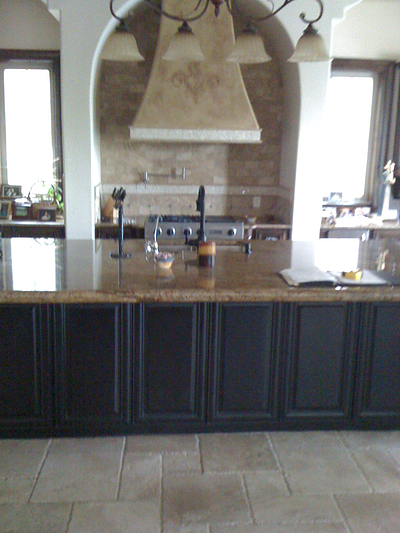
Any Austin kitchen remodel will need to produce a better service or work triangle between the sink, refrigerator, and stove placement. The shorter the sum of the triangle legs the more efficient the layout but islands can also be incorporated into the design to increase the efficiency. The prep sink within the island can become it's own focal point of the work triangle displacing the duties of the main kitchen sink. The orientation of the island toward the work triangle is very important making sure traffic can still flow freely within the designated triangle. Islands can contain all sorts of special storage areas. Mixer lifts, produce storage drawers, wine storage, and dough board pullouts are just a few of the many useful aspects that can be incorporated into the island.
Placing the dishwasher beside the sink and raising it up slightly above the floor makes reaching in to load or empty the machine a more comfortable activity. Placing the spice drawers or shelves next to the cook stove also makes good sense. Storage of pots and pans must also be placed within the vicinity of the stove. Cooking and eating utensils must have their place between the stove and sink according to use. Task lighting is a concern making sure there is plenty of light to function properly as well as placing adequate light used over the main kitchen sink. Roll out trash bins or pull out shelves are a consideration during the layout process. Let's not forget ADA remodeling concepts for comfort if you are preparing for the future.
Whatever your situation please rely on the experiences of a local building professional. Check out their credentials and references over merely price checks against other bidders. Don't make the mistake of letting a cabinet making sub play the part of a general contractor because his knowledge will be limited to that of the cabinets and not much else. You get what you pay for with proper planning.
Call T-Square Company today at 512-444-0097 today for a complete design/build experience for the new kitchen or bathroom you've longed for. Let our decades of kitchen remodeling experience guide you through what can be a stressful event.
Tags:
Austin,
fine kitchen upgrades,
kitchen remodeling,
kitchen makeovers,
how-to,
fine cabinetry,
kitchen cabinetry,
ADA compliant kitchen cabinets,
ADA remodeling,
Austin kitchen remodeling,
kitchen remodeling ideas,
kitchen remodel ideas,
Austin kitchen remodels,
Austin kitchen remodel,
kitchen cabinets Austin Texas,
kitchen remodeling in Austin Texas,
kitchen cabinets Austin,
Austin Texas kitchen remodel,
kitchen remodels austin,
artistic kitchen upgrades Austin, Texas
When dealing with any aspect of Austin commercial construction always hire a construction professional who has the experience needed to see through the gray parts of any design ideas. A very good tenant improvement contractor like T-Square Company can help with the functionality of your new commercial cabinetry. Focusing on only one idea a paid designer furnishes won't solve the function of the commercial cabinetry project. Experience goes well beyond the primary idea presented in the line drawing. You need help in order to know what parts of the design need to be and can be tweeked so that the total function of the commercial cabinetry can be realized.
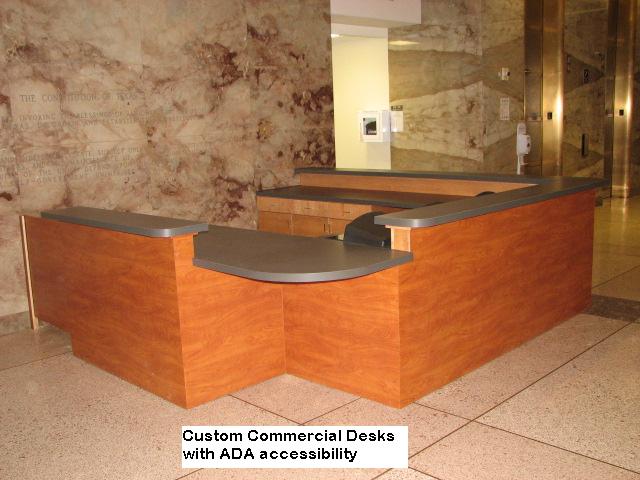
Whether you are dealing in commercial bathroom remodeling, breakroom upgrades, or are in the need of an interesting reception desk you will need the help of a reputable commercial contractor. Every design that will be located within the common area must follow ADA rules for accessibility. Service desks should have designated areas with lowered heights and roll under capabilities to serve the people with special needs. Any commercial cabinetry not located within the common area can take on standard heights and depths.

Commercial cabinetry and commercial office cabinets in Austin, because of the increased use, must pass the durability test. Many people use and are constantly around pieces like reception desks and the traffic must flow well. All surfaces must be durable and be able to take a pounding. Proper drawer guides must be adequately matched with drawer content weight. Shelf brackets should also fit the weight of the materials they are holding up. Counter tops must be tough but look sharp. Reach limits must be realized and comfortable so that the user never has to leave his or her chair.
Before you hire a commercial construction company in Austin, Texas be sure you know their capabilities so that you can trust their judgement. Your project will go smoother when you can fully rely on your chosen qualified commercial builder.
Tags:
Austin,
Texas,
how-to,
fine cabinetry,
commercial cabinetry,
ADA compliant kitchen cabinets,
Commercial Construction,
ADA accessible,
accessible routes,
ADA bathroom cabinets accessible routes,
ADA remodeling,
ADA bathroom cabinets,
ADA compliance,
ADA kitchen cabinets,
ADA vanities,
accessibility designs Austin Texas,
Austin commercial office cabinets,
commercial office cabinetry,
commercial office cabinets,
Austin commercial office cabinetry,
commercial cabinets Austin,
commercial office cabinetry in Austin,
Austin office cabinetry,
Austin office cabinets
Finding the right contractor with ADA knowledge and experience can be as much of a challenge as maintaining your independence throughout an accessible wheelchair design in Austin. You should be looking for a contractor who understands life changes. A contractor who offers specialty products and services standing out from the rest of the pack. A contractor who has the ability, through experience, to help clear the murky water impeding your accessible route and how it can be accomplished. One who takes ADA remodeling to another level promoting safety. A well versed construction professional can take on and solve any residential ADA challenge creating an accessible design. These can include widening doorways, ADA compliant kitchen cabinets, or ADA compatible baths.
Door widening is a common problem especially where wheelchair access is a must. All doors should be 36" wide with the correct locking hardware installed. The rule is 32" clear within the accessible route but 32" doors don't give enough clearance because of their stops. You also need to pay attention to which side the lockset is installed on to not limit any wheelchair access or operation of the door's locking hardware.
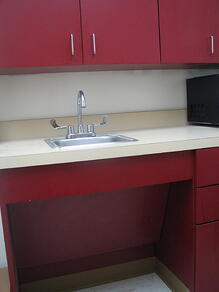
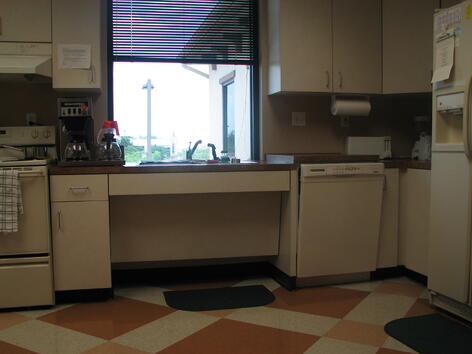
ADA compliant kitchen cabinets give you the ability to freely roll under the correct depth sink with covered or insulated water and drain lines. The sink should be equipped with a proper automatic or wrist handle faucet. A finished cabinet top height of 34" will also be observed. Wall cabinets should be mounted around 4" lower than usual for reachability from a sitting position. An unobstructed five feet turning radius on the floor should also be maintained.

Bathroom transformations complying with ADA revisions also require the same turning radius noted in the kitchen along with a correct bathing facility. If a tub is useful, correctly placed grab bars must be installed for safety reasons. Showers can be either the roll in or transfer type dictated by the individual user's physical abilities. The comfort height toilet should have grab bars installed at 34" on the side wall as well as at the rear at a minimum. The flush handle should be oriented toward the middle of the room away from the side wall. The bathroom sink should be accessible as in the kitchen mentioned above.
A Correct Kitchen Sink With Adequate Knee Clearance in The Accessible Route
Traditional home builders and remodelers don't really consider the needs of the disabled or elderly like ADA vanities or roll in showers which are universal in nature. It takes a special breed of contractor to realize special needs for special people.
A revolution in building design standards is long overdue. Our current building design standards do not address the needs of more than one third of our existing population. Many more people can greatly benefit from accessible design versus conventional design. Our rapidly aging population is experiencing the limitations of our personal living environments. Any evolution in building practically always begins in the common areas of the commercial building sector. The American Disabilities Act of 1990 increased the attention needed for those people having the right to equally access their work place and any recreational or leisure facilities. These rules at least offer minimal solutions for those needing the most help with any building access. In Austin, we now must provide access to one bathroom on the first floor in new homes as deemed by our newly adopted building regulations. This basic right to a handicap accessible bathroom is finally being enforced by the city's building inspectors. What a tremendous needed and basic design improvement!
Aging in place construction and Austin ADA remodeling has become synonymous with handicap accessible home design and modification during our lifetime. Home modifications can be used to accommodate anyone from people with mobility impairments to those with vision loss, hearing loss, or even cognitive or developmental disabilities. Accessibility home modifications or wheelchair accessible kitchen and bathroom remodeling in Austin will allow anyone with limited mobility within your home to feel more empowered and independent. The extent of a customized accessibility design is dependent upon the activity level of the person requiring the modifications.
Aging in place home modifications are available through T-Square Company in the Austin area. We have an A plus rating with the local BBB and have over 30 years of remodeling experience. We are additionally a certified aging in place specialist offering complete aging in place services. Each design/build situation will be customized to fit your personal needs increasing your accessibility. Call 512-444-0097 today to begin the accessible second chapter of your life while remaining safe and secure in your existing home. CAPS #1636580
Tags:
Texas,
kitchen remodeling,
how-to,
ADA compliant kitchen cabinets,
ADA accessible,
accessible routes,
ADA bathroom cabinets accessible routes,
wheelchair accessible remodeling,
wheelchair accessible baths and kitchens,
ADA remodeling,
ADA bathroom cabinets,
accessibility home remodeling in Austin,
accessible home remodeling,
Austin bathroom remodel,
home modifications for independent living,
handicap remodeling contractors in Austin,
remodel bathroom for handicap Austin Texas,
handicap home modifications for disabled,
handicap remodeling contractors,
home modifications Austin, Texas,
ADA remodeling Austin, Texas,
ADA bathroom Austin, Texas
Elder design takes on many facets because everyone ages differently. Once you pass through the entry door that begins a designated accessible route, the next phase of any ADA remodeling for greater accessibility includes making all destinations wheel chair accessible. Everyone requires the unrestricted use of any sinks and bathing facilities to promote personal hygiene and independence for any Austin bathroom remodel. This includes the sinks in both the kitchen and bath areas installed within ADA compliant cabinets at the correct 34 inch height. Roll under capability for wheelchair access will be included maintaining the proper clearances underneath the vanity during any bathroom modifications for elderly people. Furthermore those sinks must have accessible faucets with either automatic dispensing capabilities or manually operated blade (wrist) handles. Both the water supply lines and the sink drain underneath must be insulated or covered to prevent scalding when remodeling a bathroom with disability access.
Wheelchair Accessible Vanities
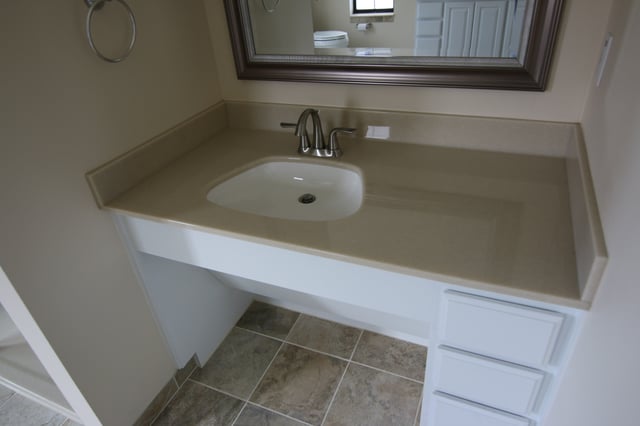
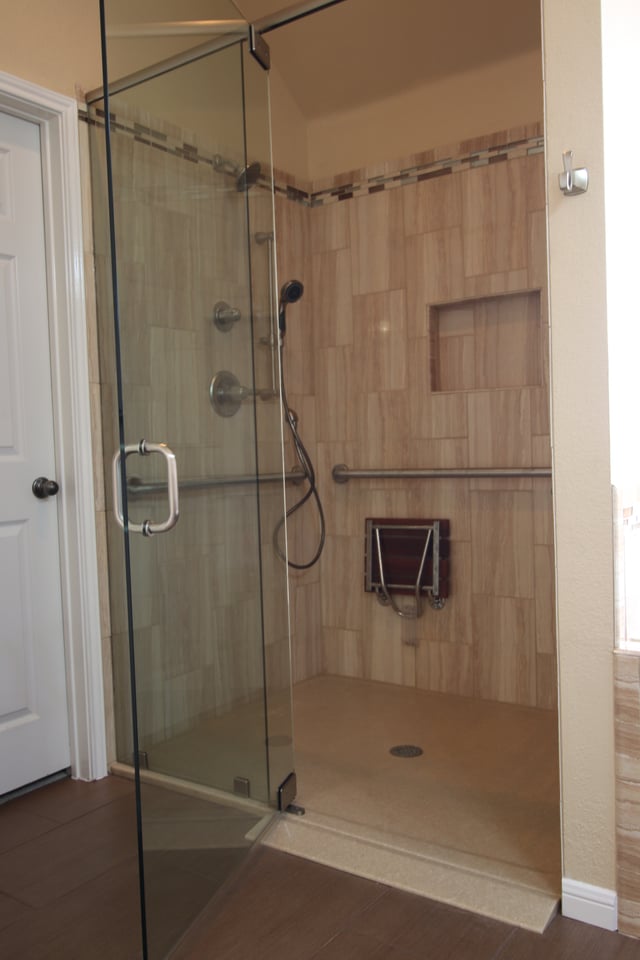
ADA accessible baths from a bath tub standpoint are generally limited to showers and the type of shower used is determined by the end user's physical capabilities. ADA compatible showers typically offer roll in or transfer situations. Custom tub shower conversions should be totally accessible. Regardless of the type ADA shower being used, a proper half inch threshold at the shower entrance should be observed for a custom walk in shower or you will need a means to add a ramp later. The splashing drawback of this situation can be remedied by installing a second wet trap floor drain overcoming any sewer gas problems arising from a dry trap.
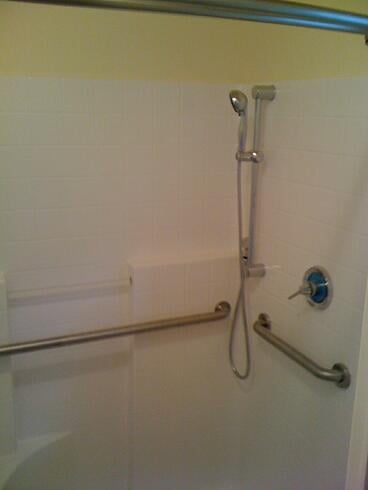
The water controls located within the ADA accessible shower from a custom tub to shower conversion should include an easily adjustable faucet for temperature control with an automatic scald guard shield and an adjustable sliding wall mount capable of holding a hand held shower wand if desired. When the hand held shower is not mounted the user can rinse off easier using it as a hand held unit. The installation of grab bars as needed is a must.
Roll In Showers

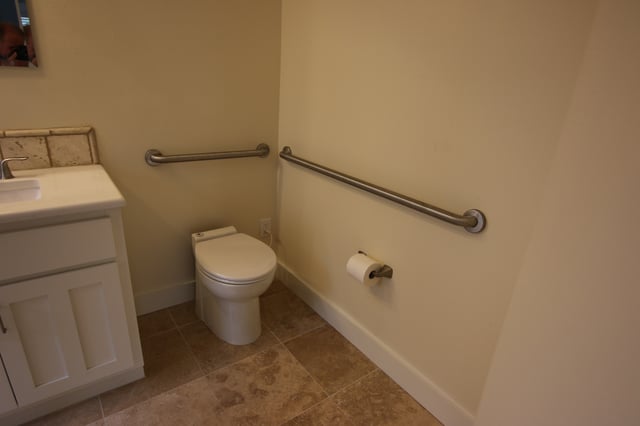
Toilets need to have the flush handle located toward the middle of the room and be of the correct height for comfort. Proper clearance from any walls must be observed and the approach to the toilet must be maintained. Grab bars should be installed both on the rear and sidewall of the toilet at 34 inches above the floor. Any bathroom transformation needs to include universal design characteristics and be accessible to everyone in the home.
Remember to choose a remodeling contractor with ADA experience who is CAPS certified to show you how to get the greatest accessibility for your evolving lifestyle.

Tags:
how-to,
ADA compliant kitchen cabinets,
ADA accessible,
ADA bathroom cabinets accessible routes,
aging in place home modifications,
ADA remodeling,
CAPS certified remodeling in Austin,
ADA kitchen cabinets,
accessibility home remodeling in Austin,
accessible home remodeling,
bathroom modifications for elderly,
aging in place specialist,
aging in place services,
Austin elder construction,
bathroom modifications for disabled,
ADA vanities,
bathroom accessibility remodels in Austin,
accessibility remodelers in Austin,
ADA remodeling Austin, Texas,
ADA bathroom Austin, Texas,
accessibility designs Austin Texas,
handicap bathrooms
Many of us will face at least a temporary disability during our lifetime requiring some alterations to our living space. Those changes which will greatly aid in maneuvering through our daily routines. The temporary or permanent use of mobility devices signifies a lifestyle change in anyone's future often as a result of an accident. This situation can make getting around safely in our home much more difficult. The often used daily paths in our lives will be disrupted and complicated if you find yourself using a wheelchair or walker as a permanent means of mobility.
Keeping ourselves independent requires planning during handicap remodeling projects providing accessible routes throughout the home. Sometimes just entering the home can be a problem if you find yourself in a wheelchair pondering on how to negotiate the steps leading to your front door. Traditional home builders have never considered the issues affecting mobility for the disabled or elderly.
ADA remodeling and universal design ideas begin at the front door using ramps to get around the stair issue mentioned above. The front door may need to have locking hardware complying with special needs. Once inside the home, an accessible design and designated route will let you reach the kitchen or bath without restrictions. The adjusted clearances between walls within a hallway will be wide enough (42" or more) for a smooth passage. Widening the entrances to all rooms to 32" or greater means you can now maneuver throughout the home. By using the correct lever door hardware you will no longer impede mobility creating frustration while moving about. Having an unobstructed turning radius of five feet within each room is also very important for wheelchair maneuvering, especially in the bathroom.
What really defines the accessible homes of Austin? Barrier free architectural design and accessibility for all who enter the structure while approaching the main living areas of the home in question is a fair definition. Universal design and aging in place trends have taken hold in the residential remodeling industry. The current housing inventory doesn't offer the features needed for safety and accessibility in the numbers needed to accommodate the ever growing demand. It is ultimately up to the individual homeowners and their families to plan for future housing needs. Once it is discovered that modifications to an existing home are not possible to accomplish total accessibility then it is time to consider a newer or custom built accessible home. What are the main design issues regarding aging in place home modifications in Austin?
- Low maintenance with little need for landscaping or exterior upkeep which could translate into newer rather than older homes that are the accessible homes of Austin.
- An accessible level entry either achieved with ramps or the rare flat lot in Austin. Consumers are looking for the free maneuverability that more open floor plans offer having greater clear unobstructed floor space. Wider doorways and unobstructed accessible routes are truly a concern. These structures will provide flat floors without transitions requiring steps or stairs to move around.
- An accessible master suite and kitchen located on the same floor is preferable. If two story homes are mandated by the community then the guests will inhabit the second floor. If the master suite needs to be located on the second floor then closets can be stacked to house a future elevator installation.
- Evolving kitchens have sprung up due to the more open floor plans. Fewer wall cabinets, lowered cabinet tops, pullout shelves or specialized drawers, and a reduced number of mobility obstructing doors represent the evolution of today's cabinetry. Knee spaces can be incorporated into a kitchen design for roll under access to the sink, prep area, and cook top. Higher toe kicks can facilitate greater wheelchair access.
- Appliances are being installed at more comfortable heights due to decreased reach distances and bending motion. Raised dishwashers, refrigerator drawers, dish washing drawers, and non-stacked double ovens are just a few changes within the appliance world. Microwaves can be installed below the cabinet top and cook tops with controls located on the front represent another appliance metamorphosis helping with reach problems.
- The lack of cabinet doors creating a new accessible open look for cabinetry is taking hold on the market. This is becoming more popular in both the bath and kitchen of accessible homes.
- Bathroom vanities with universal height cabinet tops and open knee spaces are taking over the marketplace. These new residential vanities do not need to look institutional. They can be designed like any other piece of fine furniture. Comfort height toilets covered with any one of a multitude of available seats to fit every need prevent deep knee bends required for seating. Curbless roll in showers are advised for everyone on a universal level. The shower should contain at least a shower wand on a sliding bar to be available for varying heights of use along with a regular height shower head with diverter control if desired. Folding seats are useful if caretakers are involved and secure grab bars around the shower perimeter will increase the safety factor and prevent falls. All of the bathroom floor surface must be nonskid to prevent slipping on a guaranteed wet floor.

Finding a contractor familiar with the guidelines of accessibility can be quite difficult. Be sure to check out the credentials of any potential bidders you contact. Be sure they understand that the alterations you are seeking are for wheel chair accessible home remodeling and modifications. Furthermore be sure this person knows and practices both the federal and most importantly your state's requirements before entering into any contract.
Let's face it, accessible homes are needed by all of us at some time in our lives. This is true whether it's for ourselves, a family member, or a guest. The need is certainly not driven by age but is a result of life's experience. Any family living with disability among any of the generations within it's group can always benefit from additional accessibility. This will in turn increase safety and independence for all involved as they go through life.
Aging in place home modifications are available through T-Square Company. We are a certified aging in place specialist. Each design/build situation will be customized to fit your personal needs increasing your accessibility. Call 512-444-0097 today to begin the accessible second chapter of your life while remaining safe and secure in your existing home. CAPS #1636580
Tags:
Austin,
Texas,
how-to,
ADA compliant kitchen cabinets,
ADA accessible,
accessible routes,
aging in place home modifications,
ADA remodeling,
ADA bathroom cabinets,
accessibility home remodeling in Austin,
accessible home remodeling,
bathroom modifications for elderly,
aging in place specialist,
aging in place services,
aging in place design,,
elder construction,
certified aging in place specialist,
bathroom modifications for disabled,
ADA vanities,
bathroom accessibility remodels in Austin,
accessibility remodelers in Austin,
ADA remodeling Austin, Texas,
ADA bathroom Austin, Texas,
accessibility designs Austin Texas