Check out my building blog to learn more about construction for your home or office in Austin! David L. Traut, President, CAPS Certified (512)444-0097

Proactive Aging in Place Planning: Why Flexible Home Designs Matter

Posted byDavid L. Traut, CAPS on Wed, Jun 17, 2026 @ 18:06 PM

Why Waiting Too Long Creates Bigger Problems

A thoughtfully adapted home helps preserve dignity, confidence, and independence rather than making a person feel like they are “aging into decline”, but it's how you accomplish the task that makes a huge difference. 

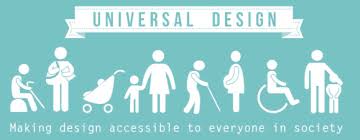
Universal Design makes a home accessible to everyone regardless of age, size, or ability.

The most successful aging in place plans are both flexible and proactive because aging is gradual, unpredictable, and constantly changing. Waiting until after a fall, hospitalization, or health crisis usually forces families into rushed decisions that are more expensive, stressful, and limiting.

Flexible Design for Changing Needs

Flexibility is equally important because physical and cognitive needs evolve. A person may be fully independent today, but later need a mobility device, reduced stair use, in-home caregiver assistance, improved visibility and lighting, easier-to-reach storage, and smart home or monitoring technology.

Universal Design and Long-Term Independence

Homes designed with Universal Design principles can adapt more easily to these changes without requiring major reconstruction later. Features such as zero-step entrances, wider doorways, lever door handles, curbless showers, more open floor plans, and reinforced bathroom walls for future grab bar installation allow the home to evolve with the homeowner.

The Benefits of Proactive Home Modifications

A proactive approach allows homeowners to prepare their environment before serious problems occur. Instead of reacting to an emergency, they can thoughtfully create a home that supports long-term independence, safety, and comfort. For example, installing better lighting, improving stair safety, widening pathways, or remodeling a bathroom early can prevent injuries before they happen. These changes are often simpler and less costly when planned rather than completed during a medical crisis.

Proactive planning also protects homeowners' emotional well-being. Many people want to remain connected to:

  • Their neighborhood
  • Friends and family
  • Familiar surroundings
  • Personal memories
  • Daily routines

Creating a Forever Home That Adapts Over Time

On the contrary, a reactive plan usually begins after experiencing a fall, hospitalization, loss of mobility, caregiver burnout, or following a sudden or extreme diagnosis.  At that point, families are often under emotional and financial pressure. Decisions become rushed, and options may be limited. In many cases, homeowners are forced into temporary solutions or premature relocation because their home was never prepared for changing needs.

In practice, the best aging-in-place plans usually happen in phases:

  1. Early prevention improvements
    Lighting, decluttering, railings, flooring, and bathroom safety.
  2. Accessibility upgrades
    Entry access, wider circulation paths, accessible kitchens,  and bathrooms.
  3. Future-readiness planning
    Smart technology, caregiver accommodations, first-floor living, adaptable spaces.
  4. Long-term adaptability
    Modifications that can evolve as health or mobility changes.

This long-range mindset is why aging in place is most successful when treated as an ongoing lifestyle and home-design strategy—not simply a reaction to aging itself.

Getting Professional Guidance

At T-Square Company, a local CAPS-Certified Builder in Austin, Texas, we help homeowners evaluate risks and implement smart, practical safety solutions tailored to their home and lifestyle. Stop procrastinating and schedule an in-home or virtual home assessment today.

Accessible Remodeling • Universal Design • Aging-in-Place

Let’s make your forever home work beautifully for you—now and for years to come.

David L. Traut, owner of T-Square Company and an active member of The National Aging in Place Council, has written an award-winning Aging in Place Guide

Age in Place at Home Book

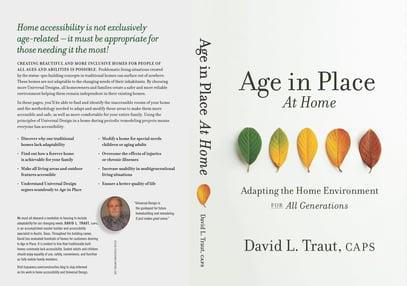
David is also certified in Universal Design in both the United States and Australia. Drawing on decades of expertise, he published Age in Place at Home: Adapting the Home Environment for All Generations, a comprehensive guide that explores the role of Universal Design in creating safe, accessible homes.

📘 Age in Place at Home takes readers room by room, explaining practical modifications that enhance safety, accessibility, and independence. The book is currently available on Amazon.

Discover the Principles Of Universal Design

Tags: aging in place remodeling, aging in place, CAPS professional in Austin, Universal Design,, accessible design, accessibility home modifications, forever home, senior safety, National Aging in Place Council NAIPC, independent living, senior home safety, home modifications for seniors, T-Square Company, multigenerational living, accessible living, bathroom safety

Telehealth and Aging in Place: How Technology Is Redefining Homes

Posted byDavid L. Traut, CAPS on Fri, Jun 12, 2026 @ 12:06 PM

The Shift—Healthcare Is Moving Into the Home 

For decades, aging in place focused on accessibility and physical safety, like installing grab bars, wider doorways, and zero-step entries. While these elements remain essential today, a new force is reshaping the industry: telehealth. Due to the technological advancement in remote monitoring, wearables, smart-home systems, and artificial intelligence, the home is becoming part of the care ecosystem itself. The best homes of the future will not simply be adapted for aging. They will be designed to respond to it.

Healthcare is no longer confined to hospitals, doctors' offices,  and clinics. Today, it’s happening in living rooms, bedrooms, kitchens, and especially in customized, flexible treatment rooms inside the home, through virtual visits and remote monitoring.

This shift is redefining what it means to create a safe and functional home that provides independence.

At T-Square Company, in Austin, Texas, we now view the home as more than a residence—it’s a care environment.


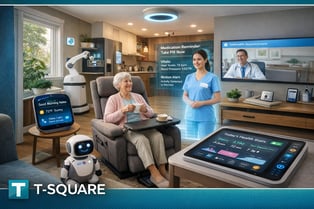
 telehealth is rapidly changing the aging in place market


Why Telehealth Is a Game-Changer for Aging in Place

Telehealth is removing one of the biggest barriers older adults face: access to care.

1. There is Easier Access to Medical Care 

The obvious benefits include that no transportation is required, there is reduced physical strain on the patient, and there is faster communication with healthcare providers.

For many seniors, especially those with mobility challenges or recovering from surgery, this is the difference between staying home and being forced to relocate.

2. Continuous Health Monitoring

Remote patient monitoring devices now track blood pressure, heart rate, blood glucose, and activity levels.

Instead of waiting for a problem to arise, healthcare providers can intervene early.

This results in fewer hospital visits and greater peace of mind for families.

3. Stronger Support Systems

Telehealth allows caregivers and family members to join virtual appointments, stay informed in real time, and coordinate care more effectively.

This creates a team-based approach to aging in place.

Key Features of a Telehealth-Ready Home

1. Reliable Connectivity

Involving Strong Wi-Fi coverage in all living areas and simple, user-friendly devices

2. Proper Lighting

Including even glare-free lighting for video calls and adjustable fixtures for aging eyes

3. Clear Acoustics

Involving reduced background noise and sound-friendly materials for better communication

4. Accessible Technology

Enhanced by easy-to-reach charging stations, devices positioned at comfortable heights, and large screens and intuitive controls

5. Private Consultation Spaces

Customized rooms for quiet, distraction-free areas and comfortable seating with proper support

How Telehealth Changes Home Design Priorities

It provides a traditional aging in place design focused on preventing falls and improving mobility.

Today, we must expand that approach.

Then vs. Now

A traditional focus was on bathroom safety, entry accessibility, and mobility within the home

The new modern focus is on digital accessibility, integrated health technology, and multi-functional living spaces

This evolution is not replacing traditional design—it’s enhancing it.

Challenges to Address

Despite its benefits, telehealth adoption still faces obstacles:

  • Many older adults are unfamiliar with technology
  • Visual, hearing, or cognitive limitations can create barriers
  • Some homes lack adequate internet infrastructure

The Solution

The answer is not less technology—it’s better design and smarter integration.

At T-Square Company, we emphasize simplicity, ease of use, and the thoughtful placement of devices

The Future of Aging in Place

Telehealth is accelerating a larger transformation:

The home is becoming a complete care ecosystem.

This includes smart home systems, remote monitoring, virtual healthcare, and caregiver coordination.

Together, these elements allow individuals to remain independent longer—safely and confidently.

Practical Steps to Create a Customized Telehealth-Ready Treatment Room

Here’s a simple checklist to get started:

  • Ensure strong Wi-Fi coverage throughout the home
  • Improve lighting in key living areas
  • Designate a quiet space for virtual appointments
  • Install accessible charging stations
  • Choose easy-to-use devices with larger displays
  • Reduce trip hazards around tech areas

Final Thoughts—Home Is Still Home

Telehealth is not just changing healthcare—it’s transforming how we think about home.

The future of aging in place is not simply staying in a home longer; it is about creating homes that actively help people remain safe, healthy, connected, and independent.

With the right modifications, aging in place is no longer just possible—it’s sustainable.

Therefore, the well-designed homes of the future will not just accommodate accessibility and aging, they will help manage it.

About the Author

David L. Traut, CAPS, is the owner of T-Square Company in Austin, Texas, and a Certified Aging-in-Place Specialist with over 30 years of experience in design/build construction. He is the author of the gold Global Book Award-winning Age in Place at Home: Adapting the Home Environment for All Generations, where he shares practical solutions for creating universally designed, safe, accessible, and comfortable living spaces. David takes you room by room, offering intelligent room modifications for aging in place.


Certified Aging In Place Specialist


Tags: CAPS, aging in place, Universal Design,, home accessibility, senior safety, home modifications, T-Square Company, smart home technology, telehealth, caregiving

National Aging in Place Council (NAIPC) ANOUNCEMENT-David L. Traut

Posted byDavid L. Traut, CAPS on Mon, May 25, 2026 @ 18:05 PM

What if your home could grow with you—supporting your independence, safety, and comfort at every stage of life?

For more than 30 years, David Traut has been helping families do exactly that. As a Certified Aging-in-Place Specialist (CAPS) and President of T-Square Company in Austin, he designs and remodels homes to remove barriers and create spaces that are both accessible and beautiful.

David’s work is rooted in a simple but powerful idea: everyone deserves to live safely and independently in the home they love. From thoughtful design to practical solutions, he helps make that possible.

He’s also the award-winning author of Age in Place at Home, where he shares guidance to help families plan with confidence.

Through his work with NAIPC, David is passionate about educating and supporting our community so more people can age in place with dignity.


For more information about David, check out his website at: https://www.tsquareco.com/home-remodeling-austin-austin-home-remodeling-bathroom-kitchen-remodels-in-austin-tx

Aging in Place Specialist David L. Traut

Let me assess your living situation to determine solutions for better home accessibility. We can accomplish this virtually or in person. Schedule an appointment today@ (512) 444-0097. We offer complete Aging in Place design/builds, consultations, and services.

Tags: aging in place, Universal Design,, certified aging in place specialist, home accessibility, home modifications, CAPS certified, T-Square Company, accessible remodeling, National Aging in Place Council, NAIPC

Future of Aging in Place: Smart Home Technology & Personalized Care

Posted byDavid L. Traut, CAPS on Tue, May 19, 2026 @ 14:05 PM

Aging in place is no longer just about grab bars and wider doorways.

Today, it’s about integrating smart technology, personalized care, and thoughtful design to create a home that actively supports independence, safety, and quality of life.

As we look toward 2026 and beyond, one thing is clear:

The home is becoming part of the care team.

future aging in place using smart home technology for personalized care


The New Model: Smart Homes + Telehealth + Human-Centered Design

Traditionally, aging in place focused on physical modifications:

  • Safer bathrooms
  • Better lighting
  • Accessible entries

Those elements are still essential—but they are now just the foundation.

The modern “Forever Home” includes:

1. Smart Home Integration

  • Voice-activated lighting and controls
  • Automated thermostats and security systems
  • Motion sensors for activity tracking

2. Remote Health Monitoring

  • Wearables tracking vitals and movement
  • Fall detection systems with instant alerts
  • Real-time health data shared with caregivers or providers

3. Telehealth Connectivity

  • Virtual doctor visits from home
  • Medication management systems
  • Ongoing care without leaving the house

This combination creates a proactive environment, not just a reactive one.


Why This Matters: Independence Without Isolation

The biggest fear many homeowners have isn’t aging—it’s losing independence.

Technology is changing that.

Instead of moving to assisted living prematurely, homeowners can now:

  • Stay in familiar surroundings
  • Maintain dignity and autonomy
  • Receive support without sacrificing privacy

At T-Square Company, we see this shift every day:

Homes are no longer passive spaces—they are active partners in care.


Design Still Comes First

Here’s the critical point many people miss:

Technology cannot replace good design. It must enhance it.

A truly successful aging-in-place strategy starts with Universal Design principles:

  • Zero-step entries
  • Wider pathways and doorways
  • Accessible bathrooms with curbless showers
  • Layered lighting for visibility and safety
  • Easy-to-reach storage

Once the home is physically accessible, technology becomes exponentially more effective.


The Rise of “Holistic Aging in Place”

The future is not just about safety—it’s about whole-life support.

A holistic approach includes:

Physical Safety

  • Fall prevention
  • Mobility-friendly layouts

Health Monitoring

  • Early detection of issues
  • Continuous care without disruption

Emotional Well-Being

  • Staying connected with family
  • Reducing isolation through technology

Care Coordination

  • Families, caregivers, and providers working together
  • Shared access to real-time information

This is where technology + personalized care models truly shine.


What Homeowners Should Be Thinking About Now

If you or your clients are planning to age in place, the question is no longer:

“What modifications do I need?”

The better question is:

“How can my home support me—physically, digitally, and emotionally—for the long term?”

Start with these priorities:

  1. Assess your current home for safety and accessibility
  2. Plan structural upgrades first (bathroom, entry, lighting)
  3. Layer in smart technology that supports daily living
  4. Consider future care needs—not just current ones

The T-Square Company Approach

At T-Square Company, we specialize in bridging the gap between:

  • Construction expertise
  • Universal Design
  • Real-world aging-in-place solutions

As a Certified Aging-in-Place Specialist (CAPS) with over 30 years in design/build, I’ve seen firsthand:

The best outcomes happen when design, technology, and care planning work together from the beginning.


Final Thought: The Home as a Partner in Living Well

The future of aging in place isn’t about staying put.

It’s about living better, longer, in a home that evolves with you.

When done right, your home becomes:

  • Safer
  • Smarter
  • More supportive
  • And ultimately… more human


T-Square Company — Austin, TX

David L. Traut, CAPS #1636580, owner/president, Member National Aging in Place Council (NAIPC)

512-444-0097

Accessible Remodeling • Universal Design • Aging-in-Place

Let’s make your forever home work beautifully for you—now and for years to come.


David L. Traut, owner of T-Square Company, has written an award-winning Aging in Place Guide

Age in Place at Home Book

David is also certified in Universal Design in both the United States and Australia. Drawing on decades of expertise, he published Age in Place at Home: Adapting the Home Environment for All Generations, a comprehensive guide that explores the role of Universal Design in creating safe, accessible homes.

📘 Age in Place at Home takes readers room by room, explaining practical modifications that enhance safety, accessibility, and independence. The book is available on Amazon.


Aging In Place Home Modifications


Tags: David L. Traut, CAPS, senior home safety, T-Square Company, aging in place technology, aging in place solutions, smart home for seniors, home health monitoring systems, universal design home modifications, telehealth at home

Bathroom Safety Upgrades That Help Seniors Stay Independent

Posted byDavid L. Traut, CAPS on Tue, Apr 07, 2026 @ 16:04 PM

The bathroom is the most dangerous room in the home for older adults. Wet surfaces, tight spaces, and the need to transfer between standing and sitting create a perfect storm for falls. Fortunately, a few targeted upgrades can dramatically improve safety and confidence.

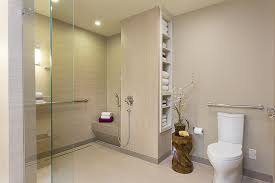
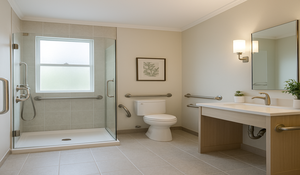
accessible bathroom with roll-in shower, roll-under vanity, and safe toilet


Why bathrooms are high risk
Slips often occur while stepping into a tub, standing from a toilet, or reaching for balance on towel racks that aren’t designed to support weight. Aging joints and slower reaction times increase the danger.

Essential bathroom safety upgrades
Grab bars are one of the most effective improvements when installed correctly near toilets and in showers. Walk-in showers reduce the need to step over high tub walls, while non-slip flooring provides traction even when wet. Comfort-height toilets and shower seats further reduce strain.

Walk-in showers vs walk-in tubs
Walk-in showers offer easy access and quick use, making them ideal for daily routines. Walk-in tubs provide soaking benefits but can be costly and take time to fill and drain, creating problems with hydrothermia for some bathers. The best choice depends on mobility and lifestyle.

Cost vs value
Bathroom safety upgrades are relatively affordable compared to hospital stays or long-term care. Even small improvements can significantly reduce fall risk.

Professional installation matters
Improperly installed grab bars or flooring can be dangerous. Professional installation ensures upgrades are secure, durable, and built to last.

T-Square Company helps homeowners create safer bathrooms that support independence without sacrificing comfort or style.

At T-Square Company, a CAPS Certified Builder,  we help homeowners evaluate risks and implement smart, practical safety solutions tailored to their home and lifestyle. 

Accessible Remodeling • Universal Design • Aging-in-Place

Let’s make your forever home work beautifully for you—now and for years to come.

David L. Traut, owner of T-Square Company, has written an Aging in Place Guide

Age in Place at Home Book

David is also certified in Universal Design in both the United States and Australia. Drawing on decades of expertise, he recently published Age in Place at Home: Adapting the Home Environment for All Generations, a comprehensive guide that explores the role of Universal Design in creating safe, accessible homes.

📘 Age in Place at Home takes readers room by room, explaining practical modifications that enhance safety, accessibility, and independence. The book is available on Amazon.

Improve Handicap Accessibility


Tags: CAPS certified remodeling in Austin, aging in place designs, disability bathroom remodeling in Austin, bathroom modifications for elderly, bathroom modifications for disabled, disability home modifications, Austin senior living solutions, age in place home design, home modifications for children with disabilities, Austin disability contractors for special needs, Austin handicap bathroom contractor, disability remodeling, ADA compliant roll in showers, accessible bathroom remodel, accessible homes in austin, Austin home remodeling for disabled, Universal Bathroom Design, Age in Place at Home, David L. Traut, CAPS, Independent living for seniors, home safety for older adults, senior home safety, T-Square Company, safe bathroom designs for seniors

Home Accessibility Modifications in Austin: A Practical Solutions Guide

Posted byDavid L. Traut, CAPS on Thu, Feb 26, 2026 @ 12:02 PM


As we age, unexpected life changes—like health diagnoses or sudden falls—can make staying in our homes feel uncertain. This guide empowers challenged homeowners, families of aging or disabled loved ones, and the professionals who support them with targeted, time-saving modifications and innovations that keep people comfortable and independent at home. With practical solutions for every scenario, you'll turn your living space into a safe, accessible home-quickly and confidently.

A home that fits you—today and tomorrow—your forever home, doesn’t happen by accident. As Austin’s pace of life hums along and families plan for multigenerational living, small design choices can make a big difference in safety, comfort, and independence. At T-Square Company in Austin, we specialize in Universal Design and Aging-in-Place remodeling that blends beautiful finishes with smart, barrier-free functionality. We understand the meaning of aging in place.

Based on David Traut's background, the owner/president of T-Square Company, and as a certified aging in place specialist and designer who recognizes how the home can be reimagined as a place we grow out of, but as one that grows with us, he is providing this roadmap for clients desiring to Age in Place. 

Below is a clear roadmap to help you understand the “what,” “why,” and “how” of making your Central Texas home more accessible—without making it look like a clinic.


What "Home Accessibility Modifications in Austin” Means in a Forever-home 

  • Universal Design home upgrades create spaces that work for everyone—kids, guests, aging parents, and you on your most tired day.
  • Aging-in-Place focuses on keeping you safely in the home you love as needs change.
  • ADA ≠ residential code. ADA is for public/commercial spaces. In homes, we use the principles—clearances, reach ranges, slip resistance—adapting them to residential scale and style.

Objections:

  • Customers fear home accessibility modifications in Austin might look “institutional” or decrease home value
  • Customers are worried about being scammed or sold unnecessary renovations
  • Clients doubt they’ll have time to manage a big project with their busy schedule
  • Consumers are unsure if changes can be made within their limited budget

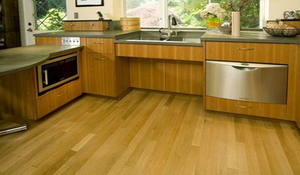
accessible kitchen upgrade


Transformation Promise:


Empower homeowners and families to age safely and comfortably at home, using proven, practical modifications that fit any home, any budget—and give them lasting confidence and peace of mind.


Timelines & Process (How We Work)

  1. Consultation & Accessibility Audit – walk-through, measurements, priorities
  2. Concept & Budget – align scope with investment; value-engineer options
  3. Detailed Design – drawings, selections, fixtures, smart-home plan
  4. Build & Protect – dust control, daily site tidiness, clear communication
  5. Training & Handover – we show you how to use every new feature confidently

Note: Structural changes (widening openings, removing walls) may require engineering review. We handle the coordination.


Austin-Specific Considerations

  • Pier-and-beam vs. slab: Many older Central Austin homes sit on pier-and-beam—great for adding drains and adapting plumbing for curbless showers. Slab homes require careful planning and often a linear drain with surface slope.

  • Heat & glare: Add shading, low-gloss finishes, and daylight-balanced bulbs for visibility without harsh reflections.

  • Storm swings: Choose exterior thresholds and drainage that handle sudden downpours without creating door-dam hazards.


Start Here: The Austin Home Accessibility Audit

When we visit your home, we walk through every space you use daily and assess:

Approach & Entry

  • One no-step entry, stable surfaces, good drainage (key in our Hill Country rains).
  • Door lighting and house numbers are visible from the street.

  1. Circulation & Doorways

    • Wider clear openings (target 34–36”), low or no thresholds.
    • Lever handles instead of knobs.
     
  2. Bathroom Safety

    • Zero-threshold shower, non-slip tile, and blocking in walls for future grab bars.
    • Shower controls at the entry, bench, or fold-down seat, handheld wand.

  3. Kitchen Function

    • Work zones with knee space, pull-outs, drawers over doors, and reachable storage.
    • Induction cooking, front-edge lighting, contrasting edges for visibility.
     
  4. Bedroom & Closet

    • Bed transfer space, rocker switches at entries, and adjustable rods/shelves.
     
  5. Lighting & Controls

    • Bright, even lighting; motion sensors in halls; smart switches within easy reach.
     
    • Continuous, low-gloss flooring; minimal height changes between rooms.

    • Floors & Transitions

You’ll get a prioritized plan: fast fixes, mid-range upgrades, and structural changes if needed.


Budgeting Wisely

  • Bundle accessibility goals with an upcoming remodel to save on labor and finishes.

  • Phase the work: start with bathrooms and entries, then kitchen and bedrooms.

  • Think resale: Universal Design often broadens your future buyer pool in Austin’s competitive market


Ready for an Accessibility Walk-Through?

Whether you’re planning or solving an immediate safety concern, T-Square Company can help you create a home that supports independence gracefully.

Book a Home Accessibility Audit (Austin and surrounding area):

  • Prioritized punch list with “Good • Better • Best” options

  • Rough budgeting guidance

  • Recommendations you can implement immediately

T-Square Company — Austin, TX

David L. Traut, CAPS #1636580, owner/president

512-444-0097

CAPS Certified Accessible Home Remodeling • Universal Design • Aging-in-Place Remodeling

Let’s make your forever home work beautifully for you—now and for years to come.

Age in Place at Home Book


David is part of a select group of professionals nationwide who have earned the Certified Aging in Place Specialist (CAPS) designation to professionally increase senior home safety improvements, including wheelchair accessible home features.

This certification, offered through the National Association of Home Builders (NAHB) in collaboration with AARP, recognizes remodelers and builders trained to meet the unique needs of older adults and individuals with disabilities. David is also an active member of the National Aging in Place Council (NAIPC).

David is also certified in Universal Design in both the United States and Australia. Drawing on decades of expertise, he recently published Age in Place at Home: Adapting the Home Environment for All Generations, a comprehensive guide that explores the role of Universal Design in creating safe, accessible homes.

📘 Age in Place at Home takes readers room by room, explaining practical modifications that enhance safety, accessibility, and independence. The book is available now on Amazon.

Certified Aging In Place Specialist

Tags: CAPS certified remodeling in Austin, aging in place services, aging in place specialist in Austin, age in place home design, accessible homes in austin, aging parents caregiver guide, home accessibility help, Universal Design Building Professional in Austin, senior home remodeling, fall prevention for seniors, home accessibility modifications in austin, T-Square Company, mobility-friendly homes, Austin home remodeling, accessible bathrooms