Check out my building blog to learn more about construction for your home or office in Austin! David L. Traut, President, CAPS Certified (512)444-0097

Disability Access Bathrooms In Austin

Posted byDavid L. Traut, CAPS on Tue, Oct 03, 2017 @ 16:10 PM

     Disability is a complex phenomenon representing an interaction between one's physical impairments, the activities they need to perform, and the architectural barriers within the space in which this situation occurs.  The terminology and jargon used for disabilities evolves regularly whereas, "handicapped" is no longer acceptable.  It is no longer merely a description of intellectual or physical impairments.  Each individual with similar impairments describes his or her limitations differently.  The blind don't experience their world the same as a person with deafness and so on. Physically challenged has become the more socially accepted description of a person with an impairment.

Certified Aging In Place Specialist

     Physical limitations affect many more people than the daily users of walkers and wheelchairs.  Many members of our life experienced or elder society have significant problems in dealing with their home environment.  Today's conventional building standards conflict with most people's accessibility when you consider our created architectural barriers concerning cabinetry and door opening widths, individual strength, range of motion, movement,  manual dexterity, balance, and coordination .  This has brought about the need for handicap bathrooms.  Once the demands of our built environment exceed their capacities we become excluded from a room or even the entire home.  The building world must work in unison to be sure the entire living environment meets basic needs in addition to affordability and structural integrity for the consumer and home owner.  Austin handicap remodeling is imperative considering bathroom remodeling includes both the home and the components within the home being accessible to all inhabitants.  Privacy, sense of belonging, sense of control, and the sense of safety and security make up the quality of life for any home and should be considered for any design.

     Designing for specific physical conditions will lessen the impact of say arthritis, restricted mobility, or loss of vision by using a combinations of products, concepts, and techniques. A trained CAPS specialist is able to identify the day to day problems weighing on those with health limitations. If you are considering an aging in place remodel for your home don't just contact any local remodeler in your area and expect a satisfactory accessible home modification.  A professional design/build accessibility project can only be created for your specific needs by a qualified home remodeler having a nationally accepted CAPS certification.  This credential is backed by the NAHB.  Only a CAPS  home remodeler possesses the specific knowledge that will insure a successful outcome for your aging in place project and what's more, keep you in your home.

     The costs involved for handicap home modifications in Austin are really dictated by the amount of barrier free accessibility required by the person needing the assistance to be safe.  Comfort and safety for the home's inhabitants are key issues when designing an accessibility remodel.  Most homeowners nationally spend between $3,800 and $14,000 with a mean average expense of $7,500.  This cost again is based on the individual home modifications providing the greatest safety for those in need.

      Falls and slips are among the most common causes causes of injury to senior and elderly people requiring disability access remodeling.  Smooth surfaces in combination with wet areas make the bathroom one of the most dangerous areas within the home.  It is of paramount importance that the bathroom be updated providing safety for any person with limited mobility or the elderly.  If you are on a tight budget and can only afford a few modifications, the bathroom is the first place to begin an accessibility remodel.  The most basic improvements to enhance safety issues are fairly inexpensive. 
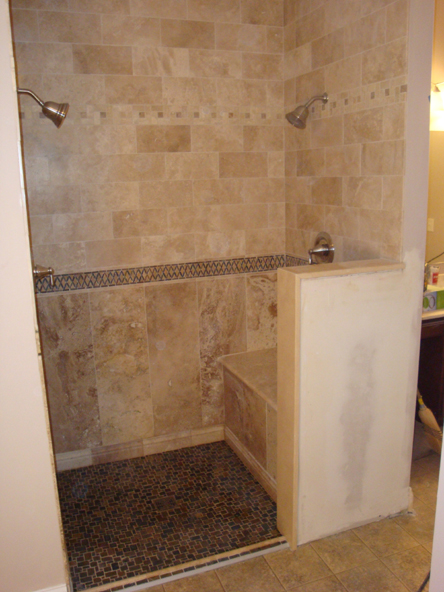
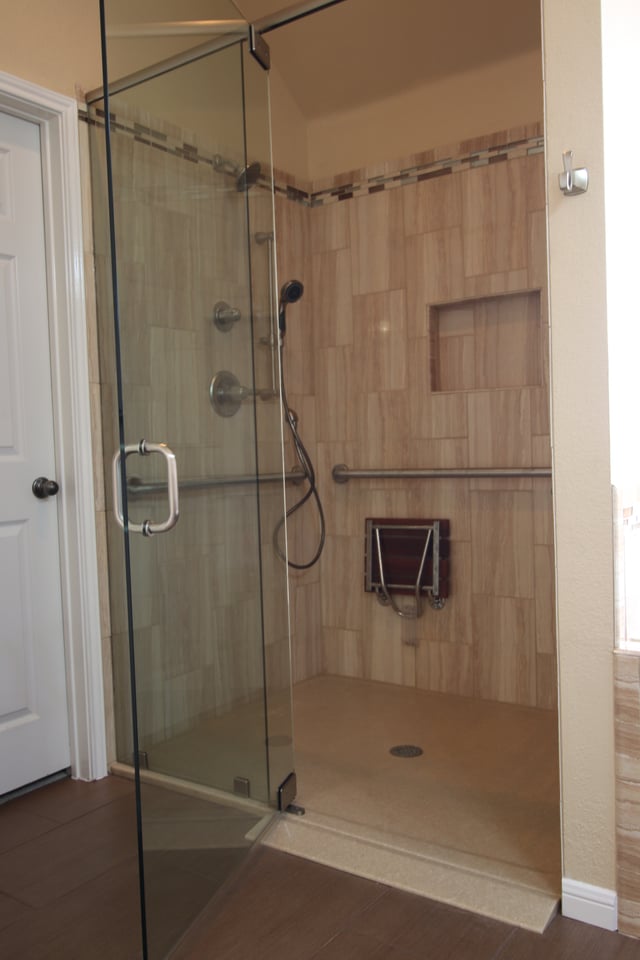
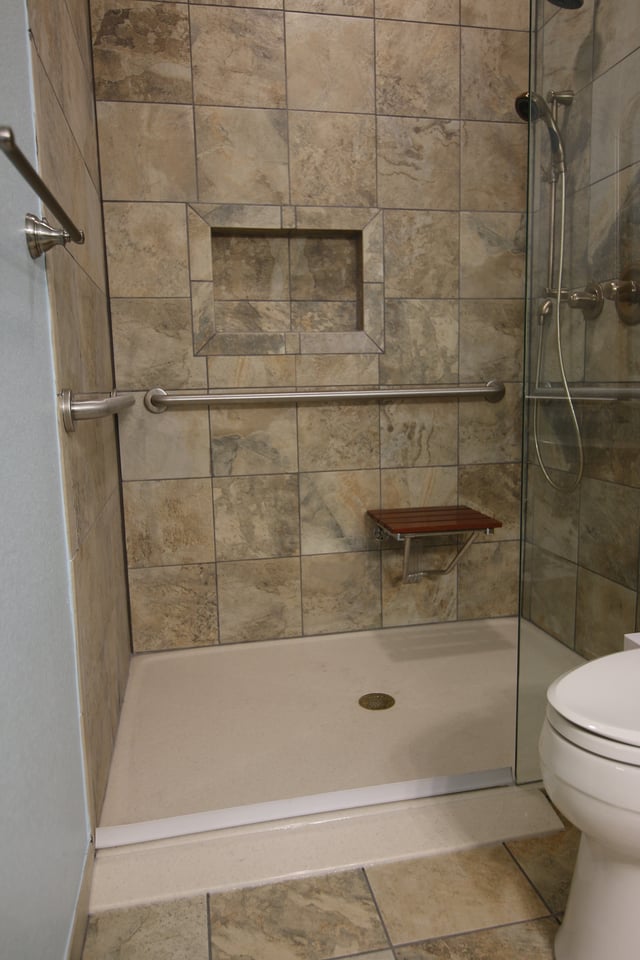
ADA  roll in shower with duel controls

Home Accessibility Help

The Top Five Items To Include When Considering An Accessible Bathroom Design

1. Vanity Sink Accessibility

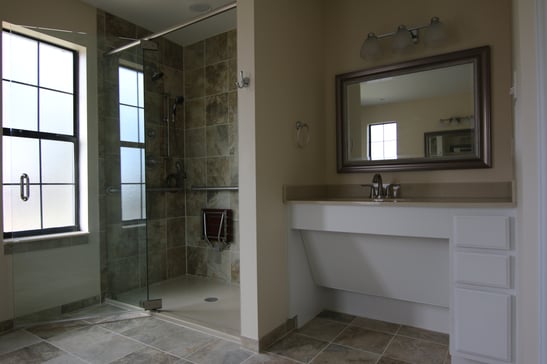
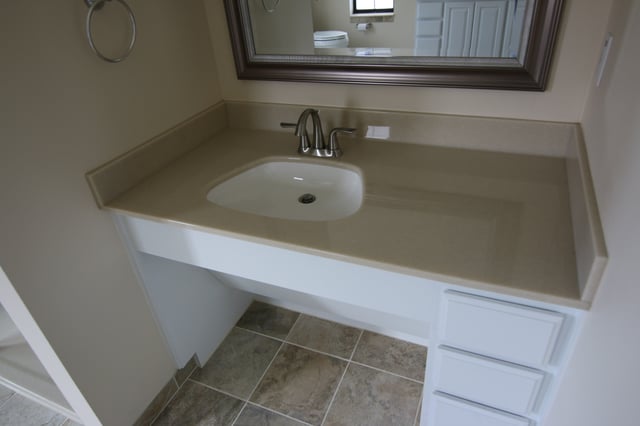
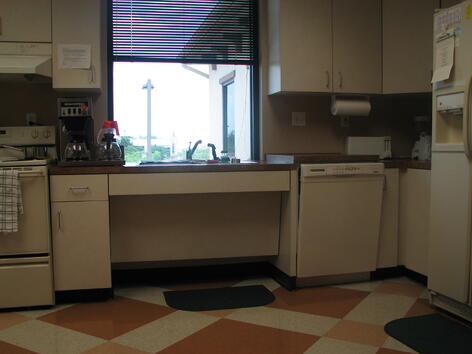
Wheelchair Accessible bathrooms today contain stylish ADA vanities set at a universal height of 34 inches with clear knee spaces.  Plan on 27 inches of vertical clearance for a wheelchair. The sink faucets must be easily controlled by either wrist handles or levers. The faucets can be fitted on the side of the sink to make them easier to reach. Or install infra-red faucets that detect motion. Hang the mirror low enough for a seated person to see themselves, and tip the top of the mirror out. Bathroom vanities with universal height cabinet tops and open knee spaces are taking over the marketplace.  These new residential vanities do not need to look institutional.  They can be designed like any other piece of fine furniture. Scalding must be guarded against by using either insulating pipe wrap or a removable panel for the plumbing.

2. Toilet Accessibility

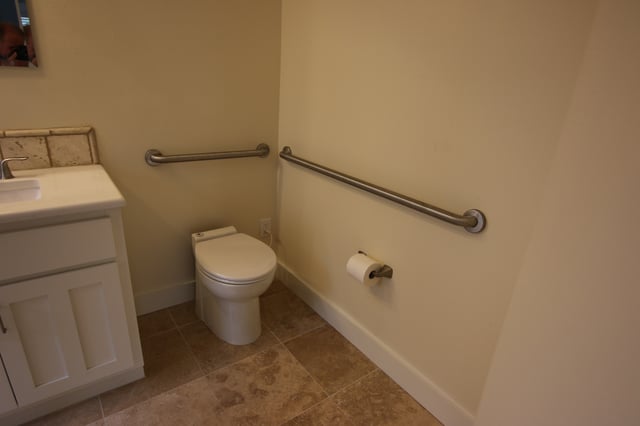
Toilets are available in comfort heights eliminating the deep knee bend needed for seating.  Grab bars should be installed on at least both sides of the toilet. Ideally, the toilet should be positioned between two support bars 36 inches apart. A toilet seat 17 inches off the floor is a more comfortable height for everyone. Creating a toilet within an open area and not a closet is much more accessible. Elevated or special toilet seats are available with a heat feature and some have the ability to self close or have a night light. A more expensive bidet/toilet is available but an add on bidet attachment to a regular toilet can be handy.

3. Bathing Facilities

Curbless roll in showers that are 5 feet wide and 3 feet deep having a 36" clear entrance are advised for everyone.  The shower should contain at least a shower wand on a sliding bar for varying heights of use along with a regular shower head and control if desired.  Installing fixtures with a scald guard or lowering the temperature at the water heater is a must to prevent burns. Folding seats in the shower are useful if caretakers are ever involved and they are much safer than a free standing shower seat which can fall over. Grab bars around the bath and especially in the shower should be used while non slip floor covering should always be considered. Walk in tubs are also a consideration but some people get chilled while the tub is draining. Install the slider bar for the hand held shower hose and head 4 feet off the floor so that the head can slide up to 6 feet high. Always use a shower valve that is thermostatically controlled and pressure-balanced to prevent scalds. If you desire a full body wash, you can include a regular shower head as well.

4. Safety and Accessibility

Always choose fixtures and fittings that are easy to control with a single hand motion or a closed fist. Motion controlled sensor fixtures are also a possibility when specifying finishes. Provide easily accessible storage compartments with pull out shelving eliminating architectural barriers by not using doors on the cabinetry. Always consider the individual needs of the occupant and find the best placement of any reachable items within their reach distance of 24". Fully consider where the best access is for all accessories such as robe hooks, towel bars, paper dispensers, soap dishes, toothbrush holders, shower shelves. The distances and clearances required will be dictated by the user and not by an accepted general outline. With falls in the wet area of the bathroom being such a great concern, a non slip tile floor should be installed without placing loose rugs in the general area. All doors should have levers instead of door knobs. The Americans with Disabilities Act requires a 5-foot turning radius for a wheelchair. But if space is tight, remodelers may be able to make do with less. "(The 5-foor turning radius) may not always be needed, especially with an electric chair, which will easily turn in a tighter space.

5. Lighting

Natural lighting is always better for anyone using the bath. Adequate task lighting in the shower, dressing area, and vanity vicinity should be installed. Lowered switches at around 48" above the floor in reaching distance should control all the lighting. You can install switches with a push button or large toggle that doesn't require a pinching motion to turn on and off. Outlets that are ground protected should be installed at 18" above the floor.

Improve Handicap Accessibility

Aging in place home modifications are available through T-Square Company. Each design/build situation will be customized to fit your personal needs. Call 512-444-0097 today to begin the accessible second chapter of your life while remaining safe and secure in your existing home. CAPS 1636580



Tags: ADA accessible, ADA bathroom cabinets accessible routes, aging in place home modifications, wheelchair accessible remodeling, CAPS certified remodeling in Austin, ADA compliance, disability bathroom remodels, accessible home remodeling, Universal Design,, Austin bath remodeling, Austin bathroom remodeling, aging in place design,, disability home modifications in Austin, Austin elder construction, handicap remodeling contractors, bathroom modifications for disabled, home improvements Austin,, accessibility remodelers in Austin, ADA remodeling Austin, Texas, ADA bathroom Austin, Texas, roll in showers, accessibility designs Austin Texas, disability access bathrooms Austin

ADA Austin

Posted byDavid L. Traut, CAPS on Tue, Oct 03, 2017 @ 11:10 AM

The ADA refers to the Americans With Disability Act developed in the 1990's to be sure any person with a disability has equal access to all public facilities and spaces. There are no restricted codes or regulations to increase accessibility for private residences concerning residential bathrooms or disability access baths. However, the published guidelines for ADA accessibility concerning public buildings and facilities is a great resource and starting point for ideas on how to make any home safer and easier to live in. Using the ADA guidelines, every design is customized around the end users abilities and body size. Homes can become more accessible through bathroom remodels to people as they age or become disabled from an accident or chronic disease. Many of these published guidelines for wheelchair accessible remodeling, particularly requirements for corridor and door widths, safety bars and proper access to different types of facilities can go a long way in extending the amount of time an elderly or physically impaired individual is able to live independently. This is the primary goal for ADA remodeling.

Many people suddenly find themselves needing accessible homes for themselves or family members. When mobility becomes an issue for any homeowner, regardless of age, the question arises concerning physically moving to a different home with a bathroom that is more accessible. Preparing for one of those highly likely events involving someone in your home needing room modifications for even a short time while recovering from surgery is surely a smart move and is the essence of proactively planning to Age in Place. Solving Aging in Place issues will soon become the number one challenge concerning the present obsolete housing inventory in our country plus the fact that people are living longer. The situation will only become ever more expanding in time.

When our homes were first purchased, they satisfied the particular family needs of the day. These homes represented an absolute castle in the world of their owners in which to prepare for a day and they also acted  as a retreat from life's tough interactions. They housed our families, our memories, and our stuff. They represented a place where we could be ourselves. Then something happens in life changing those family needs. Unfortunately, these homes have always been exempt from any and all of the accessibility regulations mentioned by the ADA.

In fact, there are approximately 30 million Americans using wheelchairs and the number of people who need accessible homes will continue to increase as disabled and aging people are finding more ways to remain living in their homes. One important way to increase independent living is making a home accessible to an individuals personal needs. Home modifications can increase safety, accessibility, and independence for people who want to live independently. T-Square Company, building in Austin, Texas,  incorporates the ADA rules in all their design/build projects, but in a customized manner. All disability home remodeling or disability bath remodels in Austin must be done considering all the data provided by the client, his or her family, and any caretakers involved. Aging in Place design should always be carried out by a seasoned Aging in Place specialist like T-Square Company.

The new evolving concept known as Universal Design and specialized handicap remodeling contractors for home remodeling is catching on nationwide and has been for several years as a sign of the times. Universal Design techniques used in building makes a home more accessible to all regardless of their mobility or adaptive abilities, and seamlessly segues into what is needed for Aging in Place. An evolution of new products used for disability home modifications is making homes more accessible and has finally come about in the remodeling industry. These new advances in accessible home remodeling not only keep the living environments safer but will not compromise the home's aesthetics.  They blend into the existing home and do not appear institutional. Universal Design principles never call attention to the family member needing them the most. In fact, there are many benefits to using Universal Design techniques, including potential use by aging family members, added resale value, and the fact that you'll be creating a space that can be used by anyone who visits your home, regardless of their range of abilities. Simple Universal Design updates for Aging in Place home modifications and handicap bathroom accessibility can include adding grab bars or handrails throughout the home, adding a seat within the roll-in-shower, lowering upper cabinets and multiple height counter tops, adding non-slip flooring, widening hallways or installing stair lifts, and widening doors. You might also consider lowering light switches and thermostats and installing easier to use door knobs. You should provide a clear barrier-free path or accessible route to the most visited areas of your home as recommended by the ADA. People who are interested in Aging in Place home improvements are now looking for a level entry into their home along with the maneuverability that a more open floor plan having greater clear unobstructed floor space presents. They desire flat floors without transitions requiring steps or stairs to move around.  Ramps having a correct 1:12 slope can be used to get them up to the level floor space at the exterior entries or the garage access. ADA compliant kitchen cabinets and ADA bathroom cabinets  in handicap bathrooms will more than likely come into play to complete any accessible home remodeling project.

Most aging baby boomers prefer one-story homes in which to Age in Place and this has become a primary reason to relocate versus a remodel.  They are looking for an accessible master suite and kitchen located on the same floor.  However, some developments mandate building two-story homes. The above requirement can be easily met by placing the guest bedrooms and accompanying bath upstairs. If the master suite for any reason needs to be upstairs, closets can be stacked between floors to house a future elevator installation.

Certified Aging In Place Specialist

Conquer A Tub To Shower Conversion


Roll In Showers

Aging In Place Home Modifications


Home Accessibility Help

The National Association of Home Builders, in partnership with the AARP and Home Innovation Research Labs, created the CAPS program, which includes training and education on the technical, business management and customer service skills essential to compete in the fastest growing segment of the residential remodeling industry--home modifications for Aging in Place and ADA accessibility in Austin, Texas.  David L. Traut, CAPS the owner and president of T-Square Company in Austin, Texas is one of the select group of professionals nationwide to earn the Certified Aging in Place Specialist (CAPS) designation, identifying him as a home remodeler and builder with the skills and knowledge necessary to remodel or modify a home to meet the unique needs of the older population, disabled owners, or their visitors. Additionally, he is certified in Universal Design in the United States and Australia. David has recently published a book called "Age in Place at Home: Adapting the Home Environment For All Generations". The book explains the importance of Universal Design in building and is available through Amazon.

Tags: ADA accessible, accessible routes, ADA bathroom cabinets accessible routes, barrier free access, aging in place remodeling, aging in place home modifications, aging in place, ADA remodeling, ADA compliance, disability bathroom remodels, accessibility home remodeling in Austin, CAPS professional in Austin, CAPS certification holder in Austin, accessible home remodeling, CAPS remodeling techniques, Universal Design,, Austin bathroom remodel, disability home remodeling in Austin, bathroom modifications for elderly, aging in place specialist, aging in place services, aging in place design,, elder construction, certified aging in place specialist, disability home modifications in Austin, Austin elder construction, handicap home modifications for disabled, handicap accessibility, bathroom modifications for disabled, bathroom accessibility remodels in Austin, accessibility remodelers in Austin, ADA bathroom Austin, Texas, accessibility designs Austin Texas, handicap bathrooms, ADA Austin

Aging In Place Specialist Austin, Texas

Posted byDavid L. Traut, CAPS on Mon, Apr 14, 2014 @ 18:04 PM

     The Center for Disease Control defines aging in place as the ability to live in one’s own home and community safely, independently, and comfortably regardless of age, income, or ability level.  Aging in place construction and remodeling has become synonymous with handicap accessible home design and modification during our lifetime.   Home modifications can be used to accomodate anyone from people with mobility impairments to those with vision loss, hearing loss, or even cognitive or developmental disabilities.  Accessibility home modifications or wheelchair accessible kitchen and bathroom remodeling in Austin will allow anyone with limited mobility within your home to feel more empowered and independent.  The extent of a customized accessibility design is dependent upon the activity level of the person requiring the modifications.  Whether someone needs a cane, walker, or wheelchair to help with mobility it is definitely a game changer for accessibility within the home.  Aging in place home modifications help people maintain their living environment for as long as it works for them before they might need assisted living care or a nursing home.

Discover the Principles Of Universal Design

Certified Aging In Place Specialist

     Some people confuse aging in place with universal design.  Both are a method to increase accessibility within the home but aging in place strictly deals with an existing home. Aging in place design also implies modifying any home for it's older occupants to insure that the inhabitants can safely remain there as long as they possibly can.  This time will expire once they need assisting medically trained help for safeguarding their personal safety in a nursing home or an assisted living environment.  Universal design is just that; offering choices to all of a home's residents no matter their age or physical capabilities.  It begins with a design and then the construction begins.  The number one safety hazard for elderly people is negotiating level changes within the home--steps at the entry, stairs between floors, and curbs to step over when entering the bath or shower.  Eliminating level changes is very difficult in existing homes and almost impossible to do aesthetically and without major compromises, unless there is a major renovation.  The result is that most homeowners decide to sell the house rather than make the modifications.  When universal design is incorporated into their design, homes can accommodate the needs of their owners as those needs evolve over time.

Download Our Free Aging In Place Remodeling Considerations Checklist

     Baby boomers in their 50's today are mostly in denial.  They generally believe that their way of life and their personal mobility are a constant.  They believe they are invincible--especially older men who will always say they don't need those types of modifications in their house.  Women in their 60's, on the other hand, seem to face facts differently acting as the caretaker of their home.  They not only watch out for the safety of themselves but for the other family members.  This is good because someone needs to be the decision maker when faced with life altering changes and what can be done about them.  The caregiver usually guides the husband into realizing that home modifications are good for everyone's safety. 

      Physical limitations affect many more people than the daily users of walkers and wheelchairs and bathroom modifications for the elderly is a sign of the times.  Many members of our life experienced or elder society have significant problems in dealing with their home environment.  Today's conventional building standards conflict with most people's accessibility when you consider our created architectural barriers concerning cabinetry and door opening widths, individual strength, range of motion, movement,  manual dexterity, balance, and coordination .  Once the demands of our built environment exceed their capacities we become excluded from a room or even the entire home.  The building world must work in unison to be sure the entire living environment meets basic needs in addition to affordability and structural integrity for the consumer and home owner.  This includes both the home and the components within the home being accessible to all inhabitants.  This will certainly require the expertise of an aging in place specialist Austin, Texas.  Privacy, sense of belonging, sense of control, and the sense of safety and security make up the quality of life for any home and should be considered for any design.

     The three main rooms involved in aging in place design and home modifications are the bathroom, the kitchen, and the family room in that order.  These areas make up the most occupied spaces of any home and will be connected by a designated accessible route.  Here we will need access through wider doorways, non slip floor surfaces, and adequate cabinet and plumbing fixture accessibility.  What is more important is that we must observe safety for everyone as the baby boomers choose to age in place within their homes.  Just remember one thing and dispel any myth that aging in place construction and remodeling must appear institutional or out of the ordinary.   When the work is done with style and taste it will only compliment the home.

Aging In Place Vanity With Accessibility

ADA vanity and roll in shower in Austin

Handicap Home Modifications

Tags: Austin, Texas, accessible routes, aging in place remodeling, aging in place, aging in place home improvements in Austin, residential remodeling, wheelchair accessible baths and kitchens, handicap home modifications, aging in place remodels, aging in place construction, aging in place designs, accessibility home remodeling in Austin, Universal Design,, Austin bathroom remodeling, disability home remodeling in Austin, disability bathroom remodeling in Austin, bathroom modifications for elderly, aging in place specialist, aging in place services, aging in place design,, Austin elder construction

Bathroom Modifications For Elderly

Posted byDavid L. Traut, CAPS on Mon, Mar 12, 2012 @ 11:03 AM

     Elder design takes on many facets because everyone ages differently.  Once you pass through the entry door that begins a designated accessible route,  the next phase of any ADA remodeling for greater accessibility includes making all destinations wheel chair accessible.  Everyone requires the unrestricted use of any sinks and bathing facilities to promote personal hygiene and independence for any Austin bathroom remodel.  This includes the sinks in both the kitchen and bath areas installed within ADA compliant cabinets at the correct 34 inch height. Roll under capability for wheelchair access will be included maintaining the proper clearances underneath the vanity during any bathroom modifications for elderly people.  Furthermore those sinks must have accessible faucets with either automatic dispensing capabilities or manually operated blade (wrist) handles.  Both the water supply lines and the sink drain underneath must be insulated or covered to prevent scalding when remodeling a bathroom with disability access.

Elder Construction

Certified Aging In Place Specialist

Wheelchair Accessible Vanities

ADA bathroom cabinet in Austin 

    ADA accessible baths from a bath tub standpoint are generally limited to showers and the type of shower used is determined by the end user's physical capabilities.  ADA compatible showers typically offer roll in or transfer situations.  Custom tub shower conversions should be totally accessible.  Regardless of the type ADA shower being used,  a proper half inch threshold at the shower entrance should be observed for a custom walk in shower or you will need a means to add a ramp later.  The splashing drawback of this situation can be remedied by installing a second wet trap floor drain overcoming any sewer gas problems arising from a dry trap.

Download Our Free Aging In Place Remodeling Considerations Checklist

     The water controls located within the ADA accessible shower from a custom tub to shower conversion should include an easily adjustable faucet for temperature control with an automatic scald guard shield and an adjustable sliding wall mount capable of holding a hand held shower wand if desired.  When the hand held shower is not mounted the user can rinse off easier using it as a hand held unit.  The installation of grab bars as needed is a must.

 Roll In Showers

IMG_0070.jpg


Improve Handicap Accessibility

     Toilets need to have the flush handle located toward the middle of the room and be of the correct height for comfort.  Proper clearance from any walls must be observed and the approach to the toilet must be maintained.  Grab bars should be installed both on the rear and sidewall of the toilet at 34 inches above the floor.  Any bathroom transformation needs to include universal design characteristics and be accessible to everyone in the home.


Allison_Tater_AIP_remodel_020.jpg

     Remember to choose a remodeling contractor with ADA experience who is CAPS certified to show you how to get the greatest accessibility for your evolving lifestyle.

ADA compliant kitchen cabinets in Austin, Texas

Austin Handicap Remodeling

Tags: how-to, ADA compliant kitchen cabinets, ADA accessible, ADA bathroom cabinets accessible routes, aging in place home modifications, ADA remodeling, CAPS certified remodeling in Austin, ADA kitchen cabinets, accessibility home remodeling in Austin, accessible home remodeling, bathroom modifications for elderly, aging in place specialist, aging in place services, Austin elder construction, bathroom modifications for disabled, ADA vanities, bathroom accessibility remodels in Austin, accessibility remodelers in Austin, ADA remodeling Austin, Texas, ADA bathroom Austin, Texas, accessibility designs Austin Texas, handicap bathrooms