Check out my building blog to learn more about construction for your home or office in Austin! David L. Traut, President, CAPS Certified (512)444-0097

Accessible Wheelchair Design In Austin

Posted byDavid L. Traut, CAPS on Mon, Apr 23, 2012 @ 11:04 AM

     Finding the right contractor with ADA knowledge and experience can be as much of a challenge as maintaining your independence throughout an accessible wheelchair design in Austin.  You should be looking for a contractor who understands life changes.  A contractor who offers specialty products and services standing out from the rest of the pack.  A contractor who has the ability, through experience,  to help clear the murky water impeding your accessible route and how it can be accomplished.  One who takes ADA remodeling to another level promoting safety.  A well versed construction professional can take on and solve any residential ADA challenge creating an accessible design.  These can include widening doorways, ADA compliant kitchen cabinets, or ADA compatible baths

Certified Aging In Place Specialist

     Door widening is a common problem especially where wheelchair access is a must.  All doors should be 36" wide with the correct locking hardware installed.  The rule is 32" clear within the accessible route but 32" doors don't give enough clearance because of their stops.  You also need to pay attention to which side the lockset is installed on to not limit any wheelchair access or operation of the door's locking hardware.

     ADA compliant kitchen cabinets give you the ability to freely roll under the correct depth sink with covered or insulated water and drain lines.  The sink should be equipped with a proper automatic or wrist handle faucet.  A finished cabinet top height of 34" will also be observed.  Wall cabinets should be mounted around 4" lower than usual for reachability from a sitting position.  An unobstructed five feet turning radius on the floor should also be maintained.

ADA Kitchen Cabinetry

     Bathroom transformations complying with ADA revisions also require the same turning radius noted in the kitchen along with a correct bathing facility.  If a tub is useful, correctly placed grab bars must be installed for safety reasons.  Showers can be either the roll in or transfer type dictated by the individual user's physical abilities.  The comfort height toilet should have grab bars installed at 34" on the side wall as well as at the rear at a minimum.  The flush handle should be oriented toward the middle of the room away from the side wall.  The bathroom sink should be accessible as in the kitchen mentioned above.

A Correct Kitchen Sink With Adequate Knee Clearance in The Accessible Route
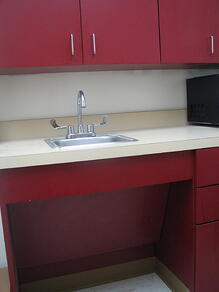
ADA accessible baths in Austin, Texas

     Traditional home builders and remodelers don't really consider the needs of the disabled or elderly like ADA vanities or roll in showers which are universal in nature.  It takes a special breed of contractor to realize special needs for special people. 

     A revolution in building design standards is long overdue.  Our current building design standards do not address the needs of more than one third of our existing population.  Many more people can greatly benefit from accessible design versus conventional design.  Our rapidly aging population is experiencing the limitations of our personal living environments.  Any evolution in building practically always begins in the common areas of the commercial building sector.  The American Disabilities Act of 1990 increased the attention needed for those people having the right to equally access their work place and any recreational or leisure facilities.  These rules at least offer minimal solutions for those needing the most help with any building access.  In Austin, we now must  provide access to one bathroom on the first floor in new homes as deemed by our newly adopted building regulations.  This basic right to a handicap accessible bathroom is finally being enforced by the city's building inspectors.  What a tremendous needed and basic design improvement!

Home Accessibility Help

    Aging in place construction and Austin ADA remodeling has become synonymous with handicap accessible home design and modification during our lifetime.   Home modifications can be used to accommodate anyone from people with mobility impairments to those with vision loss, hearing loss, or even cognitive or developmental disabilities. Accessibility home modifications or wheelchair accessible kitchen and bathroom remodeling in Austin will allow anyone with limited mobility within your home to feel more empowered and independent.  The extent of a customized accessibility design is dependent upon the activity level of the person requiring the modifications.

     Aging in place home modifications are available through T-Square Company in the Austin area. We have an A plus rating with the local BBB and have over 30 years of remodeling experience. We are additionally a certified aging in place specialist offering complete aging in place services.  Each design/build situation will be customized to fit your personal needs increasing your accessibility. Call 512-444-0097 today to begin the accessible second chapter of your life while remaining safe and secure in your existing home. CAPS #1636580

Tags: Texas, kitchen remodeling, how-to, ADA compliant kitchen cabinets, ADA accessible, accessible routes, ADA bathroom cabinets accessible routes, wheelchair accessible remodeling, wheelchair accessible baths and kitchens, ADA remodeling, ADA bathroom cabinets, accessibility home remodeling in Austin, accessible home remodeling, Austin bathroom remodel, home modifications for independent living, handicap remodeling contractors in Austin, remodel bathroom for handicap Austin Texas, handicap home modifications for disabled, handicap remodeling contractors, home modifications Austin, Texas, ADA remodeling Austin, Texas, ADA bathroom Austin, Texas

Home Remodeling Austin, Texas(part 3 0f 3)The Envelope

Posted byDavid L. Traut, CAPS on Mon, Mar 08, 2010 @ 18:03 PM

     Now that you've worked so diligently to attain the most efficient envelope for your building it's time to consider the finer points and a few energy minded construction techniques. This is why home remodeling Austin, Texas is a unique problem and furthermore why professional residential remodelers exist.   From here on out you will be dealing  with the penetrations going through your envelope perimeter that are deducting from all your efforts.  These areas include not only the electrical boxes, wires,  pipes, and registers that are coming through your walls, floor, and ceilings,but in particular the doors and windows that connect us to the outside.

     Austin house remodeling criteria demand that any penetrations concerning your utilities must be dealt with using expanding foams, caulks, or gaskets that limit infiltration into your envelope.  You can use clear paintable caulks in conjunction with all your interior trim eliminating small leaks that add up to large problems.  You can also caulk your A/C buckets to the ceiling before replacing the grilles.  Use insulation dams above attic stair units and weatherstrip the pull down door to the ceiling.  Repeat this procedure at any additional attic skuttles within your building.

     Your return air closet can also be a conditioned air thief.  Caulk all inside corners of the closet and seal your air handler to the platform it rests upon.  Weatherstrip the closet door.  If you have a gas furnace you can either remove the closet ceiling or install combustion air pipes that connect the closet to the unconditioned attic above.

     Now to attack the most wasteful of all the efficient envelope penetrators that connect us to the great outdoors-your windows. They make up a great percentage of surface area in your now upgraded and insulated exterior walls.  You must access whether or not to replace the original leaky windows and what value they add while preserving the look of your exterior.  If you choose to keep them, either efficient storm windows or insulating shutters may be installed on the interior. If, on the other hand, you favor replacing them always remember a good rule of thumb.  A single pane of glass only offers an R-1 resistance to the outside.  You are basically dealing with aesthetics  so don't be taken in by all the bell and whistle talk.  The main specification to consider is the E-factor concerning how well light is transmitted  into the building helping with direct gain problems during the summer months.

     All solid exterior doors offer insulating qualities through their makeup and must be weatherstripped.  If your doors contain glass inserts treat them as windows installing insulating shutters on the interior or a storm door on the exterior. Any penetrations through the conditioned envelope reduces it's total efficiency. 

Energy Efficient Building Techniques

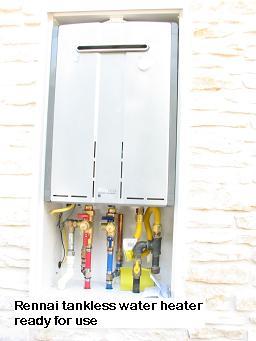
Tankless Hot Water Heaters DON'T Waste Energy Heating Water

Energy minded tankless water heaters in Austin, Texas

Check out Part 1: Ceilings which covers your attic wastes

Check out Part 2: Walls which covers your wall R-factors and underpinning

 Phote Credit: Compact fluorescent...By Mike Dykstra

Tags: how-to, efficiency, aging in place home improvements in Austin, older structures, energy minded construction, handicap home modifications, home remodeling, accessibility home remodeling in Austin, accessible home remodeling, home modifications for independent living, elder construction, home modifications Austin, Texas, home improvements Austin,, accessibility remodelers in Austin, house remodeling Austin, home remodeling Austin, Texas, house remodeling Austin, Texas, home remodels Austin, home modifications for independent living Austin

Home Remodeling Austin, Texas (Part 2 of 3) Walls

Posted byDavid L. Traut, CAPS on Mon, Mar 08, 2010 @ 18:03 PM

    Now that you've taken care of the energy being wasted "through the roof" how about those walls and what energy minded construction techniques can be utilized?  What type of construction makes up your walls and what are the best ways to go about eliminating some of the waste caused by air infiltration?  Let's define what home remodeling Austin, Texas means.

    Any remodeling contractor will tell you that Very old buildings have wall construction which is limited only by the materials that were available at the building sight for any specific time. These structures were normally composed of sod, masonry,  or logs that were chinked  with mud set into their joints relying on the principle of thermal massBy building thicker walls the same logic of the R-factor was used.  It took longer for outside temperatures to transfer into the building through these massive resistant walls into the living space.   

    Once lumber became available it was used at a premium.  The presence of clapboard or weather board construction came about using one by (one inch thick) boards in varying widths on  both sides of a 2x4 stud forming the outside walls. 

    The joints between the boards allowed air to infiltrate the building.  Batten boards were nailed over these joints on the exterior to eliminate some of the air flow and  later cheesecloth covered by wallpaper was applied on the inside boards.  The walls still had too much air infiltration relying on the dead air space and the composition of the wood itself to comprise the R-factor.  Finally 1/4" sheetrock was applied over the wallpaper as a first generation drywall application.

     If this clapboard system is plaguing your building you must access which side of the wall you need to attack.  Do you need new exterior siding that allows you to install and bury additional rigid insulation or desire a newer looking drywall finish on the interior? The only way to gain access to your stud space for applying batt insulation is to remove one side of the clap boards.  The kraft face must be turned toward your living space to create a vapor barrier against the outside and R-13 is the thickest product you can place in a four inch cavity.  Don't be misled by an offer using a blown in product that can be held up by wiring and never reach the bottom of the wall cavity which defeats the whole process.

     Once you have accomplished this task you have helped to maintain your envelope but you need to look down.  If your floor is on a pier and beam structure do you have an underpinning present?  It's purpose is to stop the wind from robbing you of additional infiltration from below your floor.  If present, the underpinning can eliminate having to install insulation between your floor joist.  It acts by literally raising the constant temperatures that existing naturally below ground.  This natural occurence will temper the crawl space beneath your floor joists and prevent energy robbing infiltration.  You now have a reasonably efficient envelope given your existing situation.

Check out Part 1:  Ceilings which covers your attic wastes

Check our Part 3:  The Envelope covering penetrations and their energy wastes

Photo Credit: Energy Savings By Prophet of the Haze

Energy Savings!

Tags: how-to, efficiency, aging in place remodeling, aging in place, aging in place home improvements in Austin, older structures, energy minded construction, home remodeling, accessibility home remodeling in Austin, disability home remodeling in Austin, home modifications for independent living, aging in place specialist, aging in place services, aging in place design,, disability home modifications in Austin, home modifications Austin, Texas, home improvements Austin,, house remodeling Austin, home remodeling Austin, Texas, house remodeling Austin, Texas, home remodels Austin

Home Remodeling Austin, Texas (part 1 of 3)Ceilings

Posted byDavid L. Traut, CAPS on Mon, Mar 08, 2010 @ 17:03 PM

     So you have recently purchased or already own a building with character but feel like it's wasting your hard earned money causing high energy bills.  What are some of the best and most cost energy minded construction techniques in Austin, Texas  you can use to help lower those "through the roof" expenses? You need to understand primarily that your ceiling is the only common denominator between your costly conditioned living space and the root of your problem---the attic.

     The greatest retrofit solution concerning home remodeling Austin, Texas is the resistance factor (R-factor) you can add above your ceiling in the form of insulation to slow down temperature exchanges and the amount is determined only by the space that you have.  If you own a building without any insulation then insulating the ceiling above the walls and floor causes the most radical changes in the way the structure responds to temperature differentials. Lay in Kraft faced batts with the paper next to your ceiling to create a vapor barrier.  If your attic has old preexisting insulation add more on top of this in the form of unfaced batts running perpendicular to your ceiling joists or apply the blown in type. 

      Remember that insulation works best when there is air surrounding each of the fibers or filaments comprising it's makeup that forms the resistance.  Settled and stomped down areas defeat the purpose by transferring temperature easier between the fibers themselves that are touching one another. Think of your attic as a heat producing battery that pushes the summer heat down through your ceiling into the conditioned space.  The air expands as the temperature increases and once the attic ventillation is overcome by sheer volume it continues to hold that increasingly heated air only to transfer the heat directly through your ceiling causing your A/C to cycle more often.  Conversely in the winter the cold intrinsic attic air takes advantage of the principle of heat rising and becomes a collecting sponge for your expensive heated air.  The presence of adequate insulation fixes both situations because the greater the R-value the better the fix.


Check out Part 2: Walls covering R-factors within your walls

Check out Part 3: The Envelope covering penetrations and their energy waste

Photo Credit: lightbulb By trulyshyazn

Energy Minded

Tags: how-to, efficiency, older structures, energy minded construction, home remodeling, home modifications for independent living, handicap remodeling contractors in Austin, handicap remodeling contractors, home modifications Austin, Texas, home improvements Austin,, accessibility remodelers in Austin, house remodeling Austin, home remodeling Austin, Texas, accessibility designs Austin Texas, house remodeling Austin, Texas, home remodels Austin, home modifications for independent living Austin