Check out my building blog to learn more about construction for your home or office in Austin! David L. Traut, President, CAPS Certified (512)444-0097

Home Accessibility Modifications in Austin: A Practical Solutions Guide

Posted byDavid L. Traut, CAPS on Thu, Feb 26, 2026 @ 12:02 PM


As we age, unexpected life changes—like health diagnoses or sudden falls—can make staying in our homes feel uncertain. This guide empowers challenged homeowners, families of aging or disabled loved ones, and the professionals who support them with targeted, time-saving modifications and innovations that keep people comfortable and independent at home. With practical solutions for every scenario, you'll turn your living space into a safe, accessible home-quickly and confidently.

A home that fits you—today and tomorrow—your forever home, doesn’t happen by accident. As Austin’s pace of life hums along and families plan for multigenerational living, small design choices can make a big difference in safety, comfort, and independence. At T-Square Company in Austin, we specialize in Universal Design and Aging-in-Place remodeling that blends beautiful finishes with smart, barrier-free functionality. We understand the meaning of aging in place.

Based on David Traut's background, the owner/president of T-Square Company, and as a certified aging in place specialist and designer who recognizes how the home can be reimagined as a place we grow out of, but as one that grows with us, he is providing this roadmap for clients desiring to Age in Place. 

Below is a clear roadmap to help you understand the “what,” “why,” and “how” of making your Central Texas home more accessible—without making it look like a clinic.


What "Home Accessibility Modifications in Austin” Means in a Forever-home 

  • Universal Design home upgrades create spaces that work for everyone—kids, guests, aging parents, and you on your most tired day.
  • Aging-in-Place focuses on keeping you safely in the home you love as needs change.
  • ADA ≠ residential code. ADA is for public/commercial spaces. In homes, we use the principles—clearances, reach ranges, slip resistance—adapting them to residential scale and style.

Objections:

  • Customers fear home accessibility modifications in Austin might look “institutional” or decrease home value
  • Customers are worried about being scammed or sold unnecessary renovations
  • Clients doubt they’ll have time to manage a big project with their busy schedule
  • Consumers are unsure if changes can be made within their limited budget
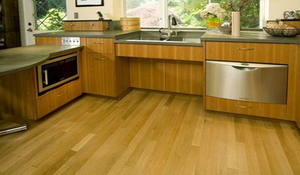
accessible kitchen upgrade


Transformation Promise:


Empower homeowners and families to age safely and comfortably at home, using proven, practical modifications that fit any home, any budget—and give them lasting confidence and peace of mind.


Timelines & Process (How We Work)

  1. Consultation & Accessibility Audit – walk-through, measurements, priorities
  2. Concept & Budget – align scope with investment; value-engineer options
  3. Detailed Design – drawings, selections, fixtures, smart-home plan
  4. Build & Protect – dust control, daily site tidiness, clear communication
  5. Training & Handover – we show you how to use every new feature confidently

Note: Structural changes (widening openings, removing walls) may require engineering review. We handle the coordination.


Austin-Specific Considerations

  • Pier-and-beam vs. slab: Many older Central Austin homes sit on pier-and-beam—great for adding drains and adapting plumbing for curbless showers. Slab homes require careful planning and often a linear drain with surface slope.

  • Heat & glare: Add shading, low-gloss finishes, and daylight-balanced bulbs for visibility without harsh reflections.

  • Storm swings: Choose exterior thresholds and drainage that handle sudden downpours without creating door-dam hazards.


Start Here: The Austin Home Accessibility Audit

When we visit your home, we walk through every space you use daily and assess:

Approach & Entry

  • One no-step entry, stable surfaces, good drainage (key in our Hill Country rains).
  • Door lighting and house numbers are visible from the street.

  1. Circulation & Doorways

    • Wider clear openings (target 34–36”), low or no thresholds.
    • Lever handles instead of knobs.
     
  2. Bathroom Safety

    • Zero-threshold shower, non-slip tile, and blocking in walls for future grab bars.
    • Shower controls at the entry, bench, or fold-down seat, handheld wand.

  3. Kitchen Function

    • Work zones with knee space, pull-outs, drawers over doors, and reachable storage.
    • Induction cooking, front-edge lighting, contrasting edges for visibility.
     
  4. Bedroom & Closet

    • Bed transfer space, rocker switches at entries, and adjustable rods/shelves.
     
  5. Lighting & Controls

    • Bright, even lighting; motion sensors in halls; smart switches within easy reach.
     
    • Continuous, low-gloss flooring; minimal height changes between rooms.

    • Floors & Transitions

You’ll get a prioritized plan: fast fixes, mid-range upgrades, and structural changes if needed.


Budgeting Wisely

  • Bundle accessibility goals with an upcoming remodel to save on labor and finishes.

  • Phase the work: start with bathrooms and entries, then kitchen and bedrooms.

  • Think resale: Universal Design often broadens your future buyer pool in Austin’s competitive market


Ready for an Accessibility Walk-Through?

Whether you’re planning or solving an immediate safety concern, T-Square Company can help you create a home that supports independence gracefully.

Book a Home Accessibility Audit (Austin and surrounding area):

  • Prioritized punch list with “Good • Better • Best” options

  • Rough budgeting guidance

  • Recommendations you can implement immediately

T-Square Company — Austin, TX

David L. Traut, CAPS #1636580, owner/president

512-444-0097

CAPS Certified Accessible Home Remodeling • Universal Design • Aging-in-Place Remodeling

Let’s make your forever home work beautifully for you—now and for years to come.
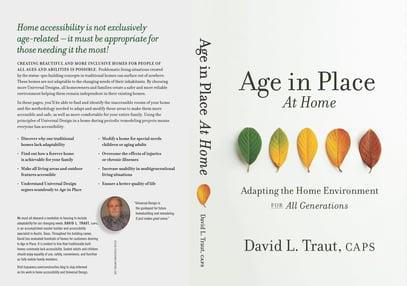
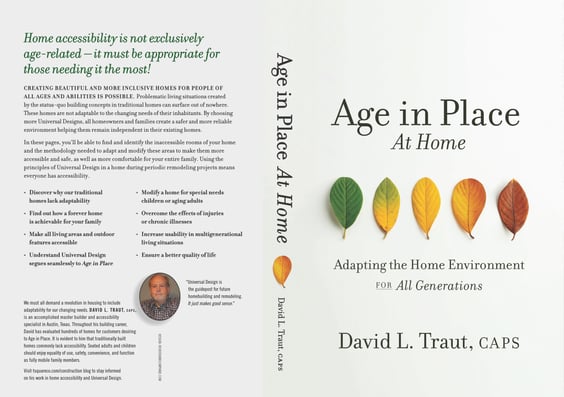
Age in Place at Home Book


David is part of a select group of professionals nationwide who have earned the Certified Aging in Place Specialist (CAPS) designation to professionally increase senior home safety improvements, including wheelchair accessible home features.

This certification, offered through the National Association of Home Builders (NAHB) in collaboration with AARP, recognizes remodelers and builders trained to meet the unique needs of older adults and individuals with disabilities. David is also an active member of the National Aging in Place Council (NAIPC).

David is also certified in Universal Design in both the United States and Australia. Drawing on decades of expertise, he recently published Age in Place at Home: Adapting the Home Environment for All Generations, a comprehensive guide that explores the role of Universal Design in creating safe, accessible homes.

📘 Age in Place at Home takes readers room by room, explaining practical modifications that enhance safety, accessibility, and independence. The book is available now on Amazon.

Certified Aging In Place Specialist

Tags: CAPS certified remodeling in Austin, aging in place services, aging in place specialist in Austin, age in place home design, accessible homes in austin, aging parents caregiver guide, home accessibility help, Universal Design Building Professional in Austin, senior home remodeling, fall prevention for seniors, home accessibility modifications in austin, T-Square Company, mobility-friendly homes, Austin home remodeling, accessible bathrooms

Understanding Disability and the Importance of Universal Design

Posted byDavid L. Traut, CAPS on Tue, Oct 28, 2025 @ 15:10 PM


Disability is a complex phenomenon — it represents the interaction between a person’s physical abilities, the activities they need to perform, and the architectural barriers within their surroundings. Each individual experiences this differently. Two people with the same impairment may describe their limitations in completely different ways. The blind navigate a world that is profoundly different from that of someone who is deaf — and both deserve spaces designed with equal accessibility in mind.

According to national reports, 19% of adults between ages 16 and 64 and 42% of those 65 and older live with a physical disability that affects their daily activities. These realities make it clear: accessibility isn’t just a senior issue — it’s a human one.


Building for All Ages and Abilities

This situation applies to everyone — adults, children, and individuals with special needs. The building industry must work together to ensure that every living environment meets essential human needs: safety, affordability, and structural integrity.

A truly accessible home supports privacy, belonging, control, safety, and security — the cornerstones of quality of life. These values should always guide the planning of any barrier-free design.

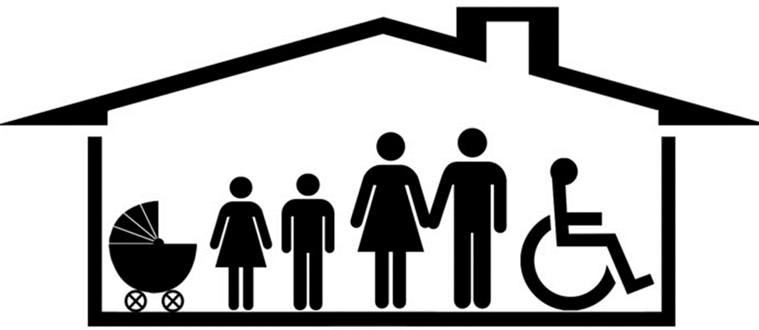
a universal design image showing all generations benefitting from its use


Common Barriers in Traditional Homes

Most traditional homes are full of hidden obstacles that restrict maneuverability for people with disabilities. These challenges become even more pronounced when mobility aids like walkers or wheelchairs are required.

Common architectural barriers include:

  • Steps at entryways with no alternative access

  • Narrow doorways and hallways with tight turns

  • Cramped bathrooms with poor fixture placement

  • Inaccessible outdoor spaces and patios

  • Kitchens that lack clear floor space or proper reach ranges

  • Hard-to-operate door hardware that requires grip strength and coordination

These design flaws can turn an ordinary house into a daily struggle for anyone with mobility limitations.


The Evolution of the Accessible Home

Accessibility has evolved far beyond grab bars and ramps. Modern accessible design is now built into the foundation of the home — seamlessly integrated rather than added as an afterthought.

This shift reflects the growing adoption of Universal Design, a concept that focuses on creating spaces, products, and environments usable by as many people as possible, regardless of age, ability, or circumstance.

Universal Design isn’t about making a home look institutional or medical. It’s about creating beauty, comfort, and functionality that everyone can enjoy — a design approach that feels natural, not clinical.

When done well, Universal Design improves safety and accessibility for every occupant and guest, often in ways that are practically invisible.


Accessible Home Design in Austin, Texas

For those in the Austin area seeking accessibility improvements, T-Square Company offers over 30 years of experience in barrier-free remodeling and accessible home design.

T-Square specializes in customized disability home modifications for residents of all ages, including:

  • Expert and professional home assessments
  • Wider doors and hallways

  • Accessible bathrooms and roll-in showers

  • Barrier-free kitchens

  • Ramped entrances and zero-threshold transitions

  • Stair lifts, elevators, and vertical platform lifts

  • Fully accessible rooms designed to each client’s needs

Every design/build project begins with a clear understanding of the client’s abilities and goals, ensuring that the design solutions enhance both independence and comfort.

Home Accessibility Help


Meet David L. Traut, CAPS

David L. Traut, CAPS, owner and president of T-Square Company in Austin, Texas, is part of a select group of professionals nationwide who have earned the Certified Aging in Place Specialist (CAPS) designation.

This certification, offered through the National Association of Home Builders (NAHB) in collaboration with AARP, recognizes remodelers and builders trained to meet the unique needs of older adults and individuals with disabilities.

David is also certified in Universal Design in both the United States and Australia. Drawing on decades of expertise, he recently published Age in Place at Home: Adapting the Home Environment for All Generations, a comprehensive guide that explores the role of Universal Design in creating safe, accessible homes. David wrote this book as a means to help families through difficult times once their homes lacked optimal livability.

📘 Age in Place at Home takes readers room by room, explaining practical modifications that enhance safety, accessibility, and independence. The book is available now on Amazon.



Living Comfortably, Safely, and Independently

Never fear — almost any existing home can be modified to overcome accessibility challenges. With proper planning, professional guidance, and a bit of creativity, you can ensure that every family member enjoys comfort, safety, and freedom of movement.

Following the guidance in Age in Place at Home will not only improve your quality of life — it will also promote equality of access for everyone under your roof.

It just makes good sense.

Tags: aging in place home modifications, CAPS certified remodeling in Austin, certified aging in place specialist, aging in place design in Austin, 7 principles of universal design, special needs contractor in Austin, Austin disability contractors for special needs, Austin aging in place specialist, disability access contractor, accessibility home modifications, Austin home accessibility solutions, CAPS-certified remodeling in Dripping Springs, Dripping Springs special needs contractor, universal design forever homes, Universal Design for Disabilities, Barrier-free designs, Universal Design Building Professional in Austin, home accessibility modifications, safe bathroom design for seniors, how to age in place

Universal Design Professional in Austin, Texas/T-Square Company

Posted byDavid L. Traut, CAPS on Fri, Oct 13, 2023 @ 09:10 AM

A universal design-build project is appealing to all users. When correctly applied, any home area will be accented universally with stylish function and appears virtually invisible. Bathrooms, kitchens, family rooms, and bedrooms will all benefit the homeowner once the principles of Universal Design are applied. Examples of increased usability provided by Universal Design include wider doorways and hallways, enhanced lighting, non-slip flooring, contrasting colors within rooms, more accessible electrical controls and devices, curb-less showers, lever door hardware, more pull-out shelves, and drawers over cabinet doors, varying cabinet top heights, and water faucets and controls operable by a single hand or closed fist. Be advised, Universal design ideas do not strictly deal with accessibility or Aging in Place design. They do not implement precise ADA standards, but offers flexibility to add accessories now and later to those planning or the end user. 

David L. Traut, CAPS (1636580), the president and owner of T-Square Company, is accredited in Universal Design in the United States and Australia and has written many papers on the subject. David not only practices integrating Universal Design in his local design/build projects, but he acts as a consultant directing customers who live out of his service area. He has now published a book covering how Universal Design overcomes today's problematic living situations within traditional homes due to their association with status-quo building concepts. Additionally, Universal Design offers a common-sense gateway for increasing accessibility and adaptability in future homes. T-Square Company in Austin, Texas has been offering design/build accessibility projects to their clients incorporating the principles of Universal Design for over twenty-five years. They specialize in Universal Design Ideas. 

Universal Design construction or inclusive construction is used when a homeowner is smartly preparing for future life changes and want to remain in their existing home. The most significant advantage of using this innovative concept is that it smoothly prepares a home for Aging in Place. By gradually applying elements of Universal Design during periodic home remodeling projects, those specific home areas affected are Age in Place ready without being noticed until needed. The concept provides various human performance characteristics for people using spaces within their homes, including well-integrated usability features. These adaptations have a broad market appeal to everyone for achieving ease of use, safety, and convenience, accommodating an inevitable reality. The effects of a disability, aging and disease are tempered because adaptability is built into the design. The reality is that all people exist along a continuum of human performance as per their traits and characteristics, regardless of their age. A universal approach to design considers that everyone has varying degrees of ability and disability rather than someone who is either fully functional or disabled.

Age in Place at Home by David Traut

 David L. Traut, CAPS, the owner-president of T-Square Company has published a book entitled "Age in Place at Home :Adapting the Home Environment for All Generations". The book is available through Amazon. This book covers identifying and overcoming common accessibility shortcomings found within a traditional home. Within it's pages, David takes you through a home's interior showing you how and where to apply Universal Design aspects in every room. Since Universal Design seamlessly segues into Aging in Place needs, it is a how-to book worth reading. Incorporating Universal Design principles into your home facilitate future Aging in Place goals, while comfortably addressing the diverse needs of all ages and mobility levels living within your home at any time. This book is a great reference for aging homeowners, parents of special needs children, homeowners moving in their elderly parents, and multi-generational living situations. Always remember, home accessibility is not exclusively age-related, but it must be appropriate for those needing it the most.

Universal Design construction and Aging in Place home modifications are available through T-Square Company in SW Austin, Texas. Each universal design/build project is customized to the homeowner's needs. Call 512-444-0097 today to prepare for the accessible second chapter of your life while remaining safe and secure in your existing home. T-Square Company will design and build an adapted living environment customized around your abilities. Whether your project concerns home modifications, an accessible addition or wing, or new construction, they can help you increase your accessibility. T-Square Company has over three decades of building and remodeling experience practicing as a disability contractor for people with special needs. They want to help their clients be as self-sufficient and independent as possible by offering handicap accessible floor plans. Let them show you how to increase safety and accessibility within your living environment.

After so long a time of blogging, soap box deliveries, and conversations with customers and other builders concerning the importance of Universal Design in the future of our home building industry, others have listened and agreed. David was humbled to find this article published in the Austin American Statesman. He takes pride in the fact that people are beginning to see the importance of this very forward-thinking design concept because it just makes good sense.  May this article help to propel the needed universal building movement forward.

Accessible Homes Of Austin


The trend toward 'universal design' in homes
Tuesday, Jan 15, 2019 @ 3:57pm
By David Wilfong

universal home design in Austin, Texas

Simple adjustments like a sideways opening oven can make life a lot easier for a person in a wheelchair. | Jofre Essley / Flickr


For many years disabled people faced challenges at every corner of public life. Stairs, rough ground, or even just reaching objects on a shelf created obstacles at inopportune times. Then the Americans with Disabilities Act (ADA) came into play. Wheelchair ramps and handicapped restrooms became commonplace in common spaces, and the result has been an improved quality of life for millions.


Then there’s the subject of home design. Homes have been modified for many years to meet the needs of the disabled, but now there is a new concept of “universal design,” which means homes being built for all needs from the beginning, even if there is not currently a disabled person living there.
“Along with aging in place, universal design is becoming more of a household term,” says T-Square Company (14141 Highway 290 West, Suite 800 in Austin) in is online blog. “Essentially, it’s about building or modifying places and spaces—both public and private—to accommodate people of all ages and abilities. More than just an architectural concept, universal design is a win-win for sandwich generation boomers caring for aging parents and their children at home, for grandparents raising grandchildren and great-grandchildren, and for all who are facing the challenges of caring for a loved one with Alzheimer’s or other chronic diseases. Whether your family needs the support now or down the road, universal design features are a good long-term investment for the home itself.”


The trend toward 'universal design' in homes
Tuesday, Jan 15, 2019 @ 3:57pm
By David Wilfong

Discover the Principles Of Universal Design


Tags: universal design/build, universal design/build ideas, universal design building for a lifetime, universal design remodeling techniques, universal design remodeling contractor, universal design building contractor, universal design principles, 7 principles of universal design, universal principles of design, disability access contractor, accessible home remodeling for disabilities, accessible bathroom design specifications, professional remodeling contractor, accessible bathroom remodel, specialty construction in Austin, accessible homes, home access in Austin, universal design/build contractor, universal design vs. aging in place, universal design contractor, home accessibility, accessible design, accessible housing, handicap accessible housing, handicap accessible house plans, accessible homes in austin, universal design techniques, Austin home remodeling for disabled, accessible home modifications, handicap accessible floor plans, accessible home builder in Austin, wheelchair accessible homes, special needs contractor, universal home design in Austin, universal design home builder, universal design home additions, universal design building consultant, universal design forever homes, Universal design construction, Universal design construction in Austin, Universal Design Professional in Austin, Universal Design Building Professional in Austin