I am a building professional who has been participating in Austin commercial construction and tenant finishes for over 30 years. I've watched beginning business owners sign a lease and blow through their seed money by purchasing costly ammenities like window walls or commercial cabinetry that could have been staged later after their initial door opening and they've logged their first dollar.
The beauty about metal stud walls below a grid ceiling is the ease of altering a given situation or floorplan. It is easier to add or remove these walls than it is the ones within your home. Electrical devices can be easily added or a lay in light fixture placed within the grid for additional lighting. That is why the systems were created since not every office configuration will work for every tenant. Even the door and window systems clip together so that they can change locations without being destroyed.
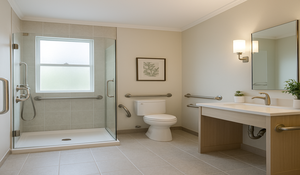
First find a trustworthy leasing agent with a good portfolio of available space for lease. If you're just starting your business find a property that you can live with for a while until your cash flow allows for office improvements. If you're established check and see if there is room for any needed expansion. Check out things like break rooms in nearby suites for future plumbing needs so that you can share a costly drain for sinks. Locate the electrical room because shorter wire runs for future circuits can save you money. Where is your space in proximity to the restrooms? Are the fire exits marked? Is the building ADA accessible? Next negotiate a multiyear deal so that your rent remains at a constant level.
Once you move in it's time to plan for the immediate future. Remember that any improvements that you make that are attached to the building must remain in place when you vacate. Be smart and be sure any alterations you perform will enhance the way the space fits your needs. Think it through and who knows, you just might become a permanent tenant at your new address.
Please call T-Square Company for all your building, remodeling needs!
512.444.0097
Or, visit our Contact Us page and fill out an online request!
Last time in Fine Kitchen Cabinetry in Austin, Texas I wrote about the cabinet carcass and the finishes applied to it's front making up a Northern face frame or a frameless European look of your fine fine cabinetry. Each type will accomodate mounting doors using a concealed Euro 32 mm bore hinge and installation is accomplished by varying the type of mounting plate that attaches to the carcass. The mounting plates are specific for the design once the doors are applied in an overlay fashion. If the doors are recessed to be flush with the carcass face then other types of hinges can be used such as wrap around or door stile bore types. Non concealed hinges come in many forms such a strap, Youngdale kerf units, flush, or offset and are used to create a certain style such as an antique look. These hinges also come in many finishes like brass, chrome, or black to name a few.
Frameless European cabinets can either be wooden or covered in plastic laminate per your choice. The laminated application makes for a cleaner application and provides for easy maintenance. These doors are flat with no crevices to conceal grease and grime.
If you go for the wooden model there are many choices from which to choose. These include a slab as above with the edges banded with heat tape or a 1/4" rip of the same wood specie as the door, a flat slab using a lip molding on the edge creating a 3/8" offset door, a raised panel with a 3/4" insert, a flat panel with a 1/4" insert, or a Shaker style with a varying divisions of the face.
Any of these will work and are truly a personal preference. So whether you are furnishing a new kitchen or bathroom space or are going for a kitchen or bath upgrade be sure you consider all the possibilities and design the room for function.
Please call T-Square Company for all your building, remodeling needs!
512.444.0097
Or, visit our Contact Us page and fill out an online request!
To determine what style of kitchen cabinets are in your home you need to look directly into their face beyond the doors. Are they the face frame North American type or are they the European frameless version?
The face frame North American type has long been a popular cabinet style. It is characterized by the plywood cabinet box, or carcass, having a 3/4" thick hardwood front frame application of 1 1/2"-2" widths. These are present on both the vertical components, or stiles, and on the horizontals called rails.
The frameless European style is just the carcass without any face frame yielding only a 3/4" outward appearance at the stiles and rails. Both the frameless and the face frame styles use the same carcass body enabling the same European hinges, drawer guides, and cabinet legs to be used.
The greatest difference is seen once the door or drawer fronts are mounted. The European frameless type makes the adjacent door spacings smaller showing less of the stile beyond. The framed units have more space between the door applications showing more of the stiles and rails beyond.
Frameless is a little less expensive to construct than the face frame style so that it really becomes a matter of personal preference and different styles can be mixed within the same house using one type in the kitchen and the other in the bath.
Please call T-Square Company for all your building, remodeling needs!
512.444.0097
Or, visit our Contact Us page and fill out an online request!
Once you've had your home for a while or have recently closed on a new property, you need to analyze and discover any deficiencies that are incorporated into the overall functionality of one of your most private rooms. Make a list of your greatest wants and desires and begin to figure out how to make them affordable and real.
Keep in mind that moving plumbing, especially drains, is one of the more expensive aspects of a bathroom upgrade involving floor demolition. If you can limit and control the costs involved with this issue you will have more money to spend on the things that show off your endeavors.
Start with your vanity cabinet(s) to see if the proper amount and kind of storage is present. Can you accomplish your needs by using specialty items like pull out shelves, miscellaneous storage add ons as in wire pullouts, tilt out trays, or simply drawer inserts separating cosmetics or medicines? If this isn't enough, your vanity cabinet can be replaced with something that's been custom made or you may be able to find an off the shelf product that solves your storage problems.
How about your tub? If it is no longer used or you have another tub in your other bathroom it can be transformed into a hower within the same footprint. You'll need to decide if you want a door and bring in the sides for the correct opening with either glass blocks or custom tile work on stick frame type construction. A walk in situation without a door requires a large enough area to enter so that the shower head is off to the side. Todays showers can get pretty fancy with body and rain heads but remember these require a larger size supply line than is normally standard. Liners beneath the floor tile can be composed of either a custom fiberglass application or the proper vinyl material. Waterproofing is the most important aspect of shower building and all precautions must be taken.
Changing your toilet is an easy way to change the look and efficiency of your bath. Older toilets use too much water when flushing and leaky flappers or malfunctioning fill valves are also water wasters. Toilets come in either a round or elongated shape and in standard and somewhat taller heights according to your comfort level.
Always be energy minded and conserve water when making alteratrions to your home.
Please call T-Square Company for all your building, remodeling needs!
512.444.0097
Or, visit our Contact Us page and fill out an online request!
Now that you've worked so diligently to attain the most efficient envelope for your building it's time to consider the finer points and a few energy minded construction techniques. From here on out you will be dealing with the penetrations going through your envelope perimeter that are deducting from all your efforts. These areas include not only the electrical boxes, wires, pipes, and registers that are coming through your walls, floor, and ceilings,but in particular the doors and windows that connect us to the outside.
Any penetrations concerning your utilities must be dealt with using expanding foams, caulks, or gaskets that limit infiltration into your envelope. You can use clear paintable caulks in conjunction with all your interior trim eliminating small leaks that add up to large problems. You can also caulk your A/C buckets to the ceiling before replacing the grilles. Use insulation dams above attic stair units and weatherstrip the pull down door to the ceiling. Repeat this procedure at any additional attic skuttles within your building.
Your return air closet can also be a conditioned air thief. Caulk all inside corners of the closet and seal your air handler to the platform it rests upon. Weatherstrip the closet door. If you have a gas furnace you can either remove the closet ceiling or install combustion air pipes that connect the closet to the unconditioned attic above.
Now to attack the most wasteful of all the efficient envelope penetrators that connect us to the great outdoors-your windows. They make up a great percentage of surface area in your now upgraded and insulated exterior walls. You must access whether or not to replace the original leaky windows and what value they add while preserving the look of your exterior. If you choose to keep them, either efficient storm windows or insulating shutters may be installed on the interior. If, on the other hand, you favor replacing them always remember a good rule of thumb. A single pane of glass only offers an R-1 resistance to the outside. You are basically dealing with aesthetics so don't be taken in by all the bell and whistle talk. The main specification to consider is the E-factor concerning how well light is transmitted into the building helping with direct gain problems during the summer months.
All solid exterior doors offer insulating qualities through their makeup and must be weatherstripped. If your doors contain glass inserts treat them as windows installing insulating shutters on the interior or a storm door on the exterior. Any penetrations through the conditioned envelope reduces it's total efficiency.
Check out Part 1: Ceilings which covers your attic wastes
Check out Part 2: Walls which covers your wall R-factors and underpinning
Phote Credit: Compact fluorscent...By Mike Dykstra
Please call T-Square Company for all your building, remodeling needs!
512.444.0097
Or, visit our Contact Us page and fill out an online request!
Now that you've taken care of the energy being wasted "through the roof" how about those walls and what energy minded construction techniques can be utilized? What type of construction makes up your walls and what are the best ways to go about eliminating some of the waste caused by air infiltration?
Very old buildings have wall construction which is limited only by the materials that were available at the building sight. These structures were normally composed of sod, masonry, or logs that were chinked with mud set into their joints relying on the principle of thermal mass. By building thicker walls the same logic of the R-factor was used. It took longer for outside temperatures to transfer into the building through these massive resistive walls into the living space.
Once lumber became available it was used at a premium. The presence of clapboard or weather board construction came about using one by (one inch thick) boards in varying widths on both sides of a 2x4 stud forming the outside walls.
The joints between the boards allowed air to infiltrate the building. Batten boards were nailed over these joints on the exterior to eliminate some of the air flow and later cheesecloth covered by wallpaper was applied on the inside boards. The walls still had too much air infiltration relying on the dead air space and the composition of the wood itself to comprise the R-factor. Finally 1/4" sheetrock was applied over the wallpaper as a first generation drywall application.
If this clapboard system is plaguing your building you must access which side of the wall you need to attack. Do you need new exterior siding that allows you to install and bury additional rigid insulation or desire a newer looking drywall finish on the interior? The only way to gain access to your stud space for applying batt insulation is to remove one side of the clap boards. The kraft face must be turned toward your living space to create a vapor barrier against the outside and R-13 is the thickest product you can place in a four inch cavity. Don't be misled by an offer using a blown in product that can be held up by wiring and never reach the bottom of the wall cavity which defeats the whole process.
Once you have accomplished this task you have helped to maintain your envelope but you need to look down. If your floor is on a pier and beam structure do you have an underpinning present? It's purpose is to stop the wind from robbing you of additional infiltration from below your floor. If present, the underpinning can eliminate having to install insulation between your floor joist. It acts by literally raising the constant temperatures that existing naturally below ground. This natural occurence will temper the crawl space beneath your floor joists and preventenergy robbing infiltration. You now have a reasonably efficient envelope given your existing situation.
Check out Part 1: Ceilings which covers your attic wastes
Check our Part 3: The Envelope covering penetrations and their energy wastes
Photo Credit: Energy Savings By Prophet of the Haze
Please call T-Square Company for all your building, remodeling needs!
512.444.0097
Or, visit our Contact Us page and fill out an online request!
So you have recently purchased or already own a building with character but feel like it's wasting your hard earned money causing high energy bills. What are some of the best and most cost energy minded construction techniques you can use to help lower those "through the roof" expenses?You need to understand primarily that your ceiling is the only common denominator between your costly conditioned living space and the root of your problem---the attic.
The greatest retrofit solution is the resistance factor (R-factor) you can add above your ceiling in the form of insulation to slow down temperature exchanges and the amount is determined only by the space that you have. If you own a building without any insulation then insulating the ceiling above the walls and floor causes the most radical changes in the way the structure responds to temperature differentials. Lay in Kraft faced batts with the paper next to your ceiling to create a vapor barrier. If your attic has old preexisting insulation add more on top of this in the form of unfaced batts running perpendicular to your ceiling joists or apply the blown in type.
Remember that insulation works best when there is air surrounding each of the fibers or filaments comprising it's makeup that forms the resistance. Settled and stomped down areas defeat the purpose by transferring temperature easier between the fibers themselves that are touching one another. Think of your attic as a heat producing battery that pushes the summer heat down through your ceiling into the conditioned space. The air expands as the temperature increases and once the attic ventillation is overcome by sheer volume it continues to hold that increasingly heated air only to transfer the heat directly through your ceiling causing your A/C to cycle more often. Conversely in the winter the cold intrinsic attic air takes advantage of the principle of heat rising and becomes a collecting sponge for your expensive heated air. The presence of adequate insulation fixes both situations because the greater the R-value the better the fix.
Check out Part 2: Walls covering R-factors within your walls
Check out Part 3: The Envelope covering penetrations and their energy waste
Photo Credit: lightbulb By trulyshyazn
Please call T-Square Company for all your building, remodeling needs!
512.444.0097
Or, visit our Contact Us page and fill out an online request!